


A vertical platform lift is an excellent accessibility solution for individuals who use mobility aids. They work best for wheelchair-bound people who have very restricted movement. A wheelchair elevator is a long-term investment that requires careful planning beforehand. A buyer has to evaluate space considerations, installation timeline, and other key factors before installing a lift. This guide simplifies the decision-making process by answering crucial questions about space, installation, and safety compliance governing residential wheelchair lift systems.
What is a Vertical Platform Lift?
Also known as a wheelchair lift, a VPL is a small elevator enabling vertical travel for disabled people. This lift offers an alternate passage for people totally dependent on wheelchairs for movement. A vertical platform lift makes use of a platform with safety walls to carry people in wheelchairs across multiple floors. It can be based on either of the two mechanisms- hydraulic or screw and nut technology.
A wheelchair lift is a space-conscious solution to ramps and stairs, especially in a residential setting.
There are other lift options, like stairlifts, that also offer multilevel mobility solutions. For instance, a platform stair lift can also carry a wheelchair across floors with a rail-mounted platform. So what makes a vertical platform lift a more suitable option?
- A VPL is not limited only to floors in a house but also offers access to decks, porches, and split levels. Other lifts are not as versatile.
- It offers 100% accessibility for people who are totally dependent on mobility aids.
- A vertical platform lift is more customisable since the design can be open or closed.
- It also works well in outdoor locations with proper weatherproofing.
- Since it has a more extensive setup, it also has a more powerful structure. It has a larger load capacity than other lifts. It can carry an additional person besides the person in the wheelchair.
What is the Minimum Space Requirement to Install a Vertical Platform Lift?
A wheelchair elevator is suitable for tight residential spaces. It can fit in a small place with its compact design. At the very least, it requires space for the platform and a small overhead pit.
- Footprint: The unit itself is approximately 4′ x 4.5′ to 5′ x 5′.
- Platform: It can be 36 inches or more based on the configuration of the lift. A straight-through wheelchair lift requires a three-by-four-foot space, while a side entry will require a minimum of three-by-five feet space for safe turning.
- Shaft: Not all designs have this requirement, so the space needed by a shaft can vary from a few inches to no space at all. Conveniently, there is no need for a separate room as it is MRL (machine room less).
The Installation Process for a Wheelchair Lift at Home
Professional Assessment
The first step is assessing the location to find the best space for the wheelchair. A team of professionals pays a visit to the property for initial evaluation. They assess the space, structural strength, and power requirements to suggest changes, if any.
Hiring an industry expert helps streamline the entire process, as they also handle the procurement of permits.
Site Preparation
Installation and Quality Check
Finally, the lift is installed. The team conducts a test run to check the features, like the control panel, speed, and emergency brakes.
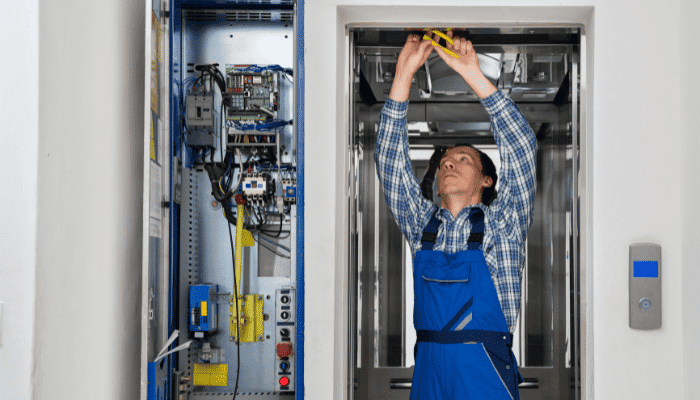
A Vertical Platform Lift Accessibility Guide for Wheelchair Users
Before installing a vertical lift at home, buyers should consider the following factors and ensure that the requirements are duly fulfilled.
-
Load Capacity
A vertical platform lift has a higher weight capacity than normal residential elevators.
- Typically, a lift meant for a wheelchair user and an additional person needs to have a load capacity of at least 200- 350 kg.
- The commonly recommended lift capacities are- 220 kg, 300kg, 340 kg.
- Some wheelchair elevators can be customized to have an even higher load capacity based on individual needs.
-
Safety Compliance
All wheelchair elevator lift systems need to follow the safety guidelines laid down by the BIS (Bureau of Indian Standards) and the NBC (National Building Code). The BIS codes- IS 14665 governs the compulsory features of electric lifts, IS 14671 is especially for the lifts for the disabled, and IS 17386 deals with modernization projects.
Key safety features-
- ARD (automatic rescue device)
- Emergency stop buttons
- Battery backup
- Overload sensors
- Non-slip surface
- Safety walls with interlocking doors
To Sum Up
A vertical platform lift is a versatile accessibility solution for residential properties. It works well in both indoor and outdoor settings. A wheelchair lift has more extensive applications as compared to other lift types and naturally requires a more comprehensive setup. Hence, it is best to consult professionals before getting a wheelchair lift for your home. They take care of the pre-installation work (permits, assessment, and associated civil work), follow safety guidelines, and also help maintain the system for long-term secure use. By planning ahead of the installation, buyers can select an optimal model that works best with their budget and space requirements.


