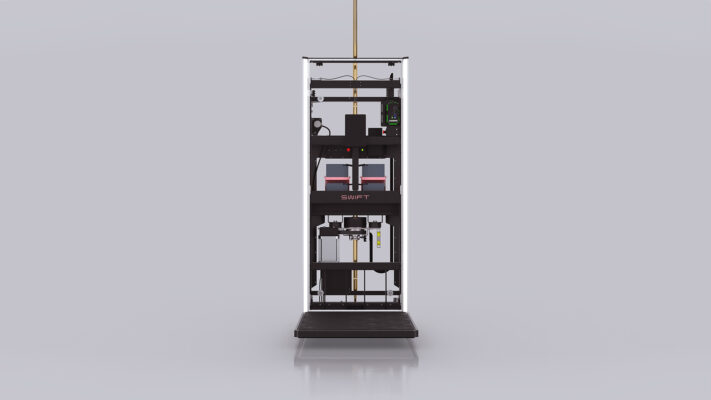
A screw-driven lift is a type of home elevator that moves using a threaded steel screw and a motorised drive nut. As the nut rotates around the screw, the lift platform travels smoothly up or down between floors. This technology is known for its reliability, compact design, and low maintenance requirements. Unlike hydraulic systems that use oil or traction lifts that rely on cables and counterweights, screw-driven systems operate with fewer moving parts and can often be installed with minimal structural changes. These advantages have made screw-driven lifts a popular choice for homeowners looking for a safe, space-efficient, and energy-conscious mobility solution.
Ready for a Premium Lift in Your Modern Home?
How Screw Lift is Designed
The SWIFT Screw lift is uniquely designed to optimize the user experience in terms of noise and smooth operation. At the same time, in a Tesla-inspired manner, we have been able to ensure that the energy created when going down can be returned to the batteries. In this way, every 4th ride is free and if the power goes out in the house, the elevator will be able to run on its batteries just as normally.
Pros & Cons of Screw-Driven Home Lifts
If you're comparing different home lift technologies, understanding the advantages and limitations of a screw-driven lift can help you choose the most suitable solution for your property.
Pros of Screw-Driven Lifts
Cons of Screw-Driven Lifts
Space-saving design – Requires minimal structural work and can often be installed without a machine room.
Lower travel speed – Typically slower than traction lifts, making them better suited to residential rather than commercial buildings.
High safety levels – The screw-and-nut mechanism provides controlled movement and reliable stopping performance.
Limited travel height – Best suited for homes and low-rise buildings rather than tall structures.
Energy efficient – Modern systems like SWIFT use regenerative battery technology that reduces electricity consumption.
Moderate load capacity – Generally designed for residential use and smaller passenger numbers.
Works during power outages – Integrated battery backup allows continued operation when mains power is unavailable.
Fewer customisation options than some commercial traction systems – Although modern models still offer extensive design choices.
Quiet and smooth operation – Optimised screw-and-nut systems minimise vibration and noise.
Low maintenance requirements – Fewer moving parts than hydraulic or traction lifts can reduce servicing needs.
No hydraulic oil required – Eliminates the risk of oil leaks and reduces environmental impact.
How Screw-Driven Lifts Compare to Other Technologies
Feature
Screw-Driven Lift
Hydraulic Lift
Traction Lift
Space Required
Very Low
Moderate to High
High
Machine Room Needed
No
Often Yes
Often Yes
Energy Efficiency
Excellent
Moderate
Good
Battery Backup
Standard on SWIFT
Usually Optional
Varies
Maintenance Needs
Low
Higher
Moderate
Noise Levels
Low
Moderate to High
Low to Moderate
Suitable for Existing Homes
Excellent
Good
Limited
Suitable for High-Rise Buildings
No
Limited
Excellent
Need Fast UK Lift Installation Advice Now?
Key Takeaway
For most homeowners, a screw-driven home lift offers an excellent balance of safety, space efficiency, energy savings, and ease of installation. While traction lifts are often preferred for tall buildings and hydraulic lifts have traditionally been used in low-rise applications, screw-driven technology is specifically designed to meet the needs of modern residential properties with minimal disruption and long-term reliability.
Main Components of a Screw-Driven Lift
A screw-driven lift uses a simple yet highly reliable mechanism designed specifically for residential applications. Understanding its key components can help homeowners appreciate how the system delivers safe, smooth, and energy-efficient travel between floors.
1. Drive Screw
The drive screw is the central vertical shaft that runs through the lift structure. It remains fixed in place while the drive nut rotates around it. The screw guides the lift platform and ensures precise vertical movement.
2. Drive Nut
The drive nut is the component that travels along the screw. When powered by the motor, it rotates around the screw, causing the lift platform to move up or down depending on the direction of rotation.
3. Electric Motor
The motor powers the drive nut and controls the lift's movement. Modern systems such as SWIFT use advanced energy-efficient motors that provide smooth acceleration, precise stopping, and quiet operation.
4. Lift Platform or Cabin
The platform or cabin is the area where passengers stand or travel. In home lifts, it is designed for comfort, accessibility, and safety while maintaining a compact footprint.
5. Guide Rails
Guide rails help keep the platform stable during travel. They minimise lateral movement and ensure a smooth ride between floors.
6. Safety Braking System
Screw-driven lifts incorporate multiple safety mechanisms, including emergency brakes and overspeed protection systems. These features help stop the lift safely if an abnormal operating condition is detected.
7. Control System
The control system manages lift operation, speed regulation, floor selection, safety monitoring, and diagnostic functions. Advanced models often include touchscreen controls and remote monitoring capabilities.
8. Battery Backup System
Many modern screw-driven lifts, including SWIFT, feature integrated battery technology. This allows the lift to continue operating during a power outage and can also recover energy during descent for improved efficiency.
9. Lift Shaft or Self-Supporting Structure
Unlike many traditional lifts, screw-driven lifts often use a self-supporting structure with integrated panels or glazing. This reduces building work and simplifies installation in existing homes.
How These Components Work Together
When a user selects a floor, the control system activates the electric motor. The motor rotates the drive nut around the fixed screw, causing the platform to travel smoothly along the guide rails. Throughout the journey, the safety systems continuously monitor operation, while the battery system provides backup power and energy optimisation.
Component Diagram
        ┌─────────────────┐
        │ Lift Structure  │
        │  / Shaft Frame  │
        └─────────────────┘
                 │
          Fixed Drive Screw
                 │
          ┌───────────┐
          │ Drive Nut │
          └───────────┘
                 │
           Electric Motor
                 │
      ┌──────────────────┐
      │ Lift Platform /  │
      │      Cabin       │
      └──────────────────┘
                 │
            Guide Rails
                 │
      Safety & Control System
                 │
         Battery Backup Unit
To provide the best experiences, we use technologies like cookies to store and/or access device information. Consenting to these technologies will allow us to process data such as browsing behavior or unique IDs on this site. Not consenting or withdrawing consent, may adversely affect certain features and functions.
Functional
Alltid aktiv
The technical storage or access is strictly necessary for the legitimate purpose of enabling the use of a specific service explicitly requested by the subscriber or user, or for the sole purpose of carrying out the transmission of a communication over an electronic communications network.
Preferences
The technical storage or access is necessary for the legitimate purpose of storing preferences that are not requested by the subscriber or user.
Statistics
The technical storage or access that is used exclusively for statistical purposes.The technical storage or access that is used exclusively for anonymous statistical purposes. Without a subpoena, voluntary compliance on the part of your Internet Service Provider, or additional records from a third party, information stored or retrieved for this purpose alone cannot usually be used to identify you.
Marketing
The technical storage or access is required to create user profiles to send advertising, or to track the user on a website or across several websites for similar marketing purposes.