

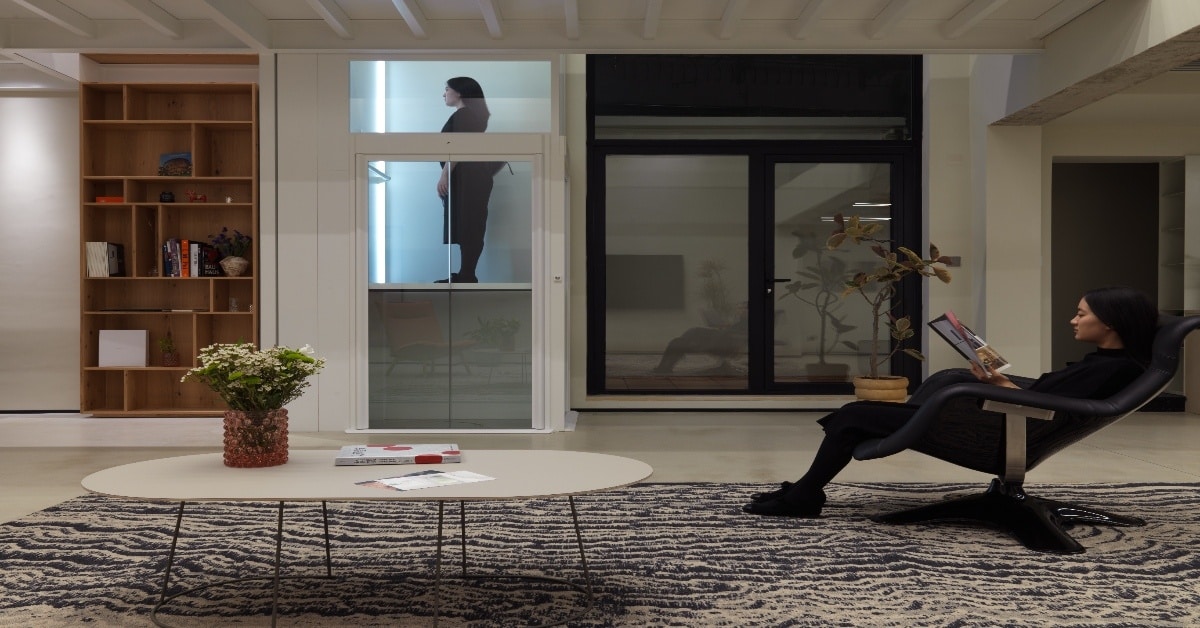
Walk into any premium home exhibition in Mumbai, Bengaluru, or Delhi and you are likely to see one.
A transparent cylindrical tube rising through the floor, a small circular cabin moving silently within it, and a cluster of curious homeowners peering at something that looks more like a design installation than a piece of domestic engineering. The pneumatic vacuum elevator has arrived in the Indian market with considerable visual impact, and the questions it generates are consistent: how does it work, what does it cost, and is it actually right for an Indian home?
This guide answers those questions honestly. It explains the technology in plain language, gives you realistic Indian price ranges, covers the genuine advantages and the genuine limitations, and compares vacuum lifts against hydraulic and shaft-free battery-powered alternatives so that Indian homeowners can make an informed decision rather than one driven by the novelty of a transparent tube.
TL;DR
- What it covers: Explains how vacuum and pneumatic home lifts work, their real world usability, costs, and how they stack up against hydraulic and battery powered alternatives.
- Who it’s for: Indian homeowners considering a vacuum lift, particularly in heritage properties or two floor bungalows with a single mobile adult user.
- Why trust it: Written by Aziz Acar, a 25+ year elevator industry veteran, backed by a detailed side by side comparison table across three lift technologies.
- Problem it solves: Highlights vacuum lifts’ hidden limitations (single person capacity, no wheelchair access, power cut behavior) so buyers avoid a mismatch with their household needs.
- Key stats: A two-floor vacuum lift costs 8 to 14 lakh rupees with 15,000 to 30,000 rupees in annual maintenance, lasts 15 to 20 years, and installs in just 2 to 3 days versus 4 to 8 weeks for hydraulic systems.
What Is a Pneumatic Vacuum Elevator and How Does It Work?
A pneumatic vacuum elevator, often called a PVE or vacuum lift, operates on a principle that most people learn in school physics but rarely expect to find in a domestic appliance. The cabin travels within a cylindrical tube using differences in air pressure above and below the cabin to drive it upward, and controlled release of pressure to allow it to descend.
To go up, a vacuum pump removes air from above the cabin inside the cylinder. The atmospheric pressure below the cabin, which remains at normal pressure, pushes the cabin upward toward the lower pressure zone above it. To come down, the pump stops and air is gradually allowed back into the cylinder above the cabin. The pressure difference equalises and the cabin descends smoothly under controlled gravity. This innovative technology is one reason pneumatic elevators are increasingly being discussed as the future of home lifts, especially for modern homes seeking compact design, minimal construction work, and advanced residential mobility solutions.
The structural implications of this mechanism are what make it interesting for Indian homeowners. Because the cylinder is self-contained and the driving force is atmospheric pressure, there is no need for a hydraulic piston and the pit that accommodates it. There is no motor room. There is no masonry shaft built floor by floor from bricks and concrete. The cylindrical tube simply passes through a circular opening cut in each floor, and the tube itself provides both the structural enclosure and the operating mechanism.
In an Indian home where creating a traditional lift shaft would mean weeks of construction and significant disruption, the idea of a self-contained tube that installs in two to three days with nothing more than circular floor openings is genuinely compelling.
The Real Experience of Using a Vacuum Lift in an Indian Home
Understanding the practical day-to-day reality of a vacuum lift in an Indian home requires going beyond the visual appeal of the transparent cylinder.
The cabin size in a standard pneumatic elevator is circular and typically measures 830 to 950 millimetres in internal diameter. This accommodates a single standing adult comfortably. A person with a compact walking stick can typically manage within the space. A rollator walking frame and user together are a very tight fit in most standard configurations. A wheelchair user cannot use a standard vacuum lift cabin because the dimensions do not accommodate a wheelchair regardless of how it is oriented.
The noise level of the vacuum pump is the aspect of vacuum lift operation that surprises Indian homeowners most consistently after installation. The pump operates during every ascent journey, and in the quiet of a private home the sound is noticeably present. In a villa or bungalow with a dedicated lift area and solid wall construction, the sound is manageable. In a compact urban apartment where rooms are adjacent to the lift position, the pump noise during operation can be a daily irritant that was not anticipated during the purchase decision.
The sensation during travel includes a mild pressure change, similar to a very gentle version of what passengers experience during aircraft descent. For most users this is unremarkable. For elderly users with certain ear or sinus conditions, or for anyone with medical sensitivity to pressure changes, this sensation warrants discussion with a doctor before a vacuum lift is selected. Homeowners comparing pneumatic elevators with modern alternatives such as the SWIFT Pro and SWIFT Lite should also consider ride comfort, cabin accessibility, and long-term usability before making a final decision.
The descent on power failure is the feature that concerns Indian homeowners most given the country’s power supply realities. When mains power is cut, the vacuum pump stops and the cabin descends automatically to the lowest floor under gravity as the pressure above equalises. The cabin arrives at the ground floor and the door can be opened normally. This is the designed safety behaviour and it is entirely safe in terms of the user arriving at the lowest floor. The implication for Indian homes, where power interruptions can occur multiple times in a day in some areas, is that anyone using the lift when power cuts will automatically be brought to the ground floor regardless of which floor they intended to reach. This may be a minor inconvenience or a significant operational issue depending on the household’s routine and the floors being used.
Vacuum Lift Price in India: What to Expect in 2026
The price of a vacuum lift in India varies depending on the number of floors served, the cabin size, the brand, and whether the product is imported or assembled locally.
For a two-floor installation with a standard single-person cabin diameter of 830 to 900 millimetres, vacuum lift prices in India typically range from 8 to 14 lakh rupees for the complete installed system including the cylinder structure, floor opening preparation, electrical connection, and commissioning.
For a three-floor installation, prices range from 11 to 18 lakh rupees depending on the brand and specification. Each additional floor extends the cylinder height and adds to the floor opening preparation costs.
Premium vacuum lift configurations with larger cabin diameters, higher-specification finishes, or bespoke customisation can exceed these ranges. Some European-origin vacuum lift systems imported through Indian distributors are priced at 15 to 22 lakh rupees or more for comparable configurations.
It is important to verify the certification status of any vacuum lift product being considered in India. CE certification indicates independent testing by a European notified body against defined safety standards. BIS certification under Indian Standards is the domestic framework. Products that lack either independent certification carry unknown safety risk. The transparent appearance of a vacuum lift can make it seem technically straightforward, but the structural loads, the door safety mechanisms, and the emergency descent behaviour all require engineering validation that only independent certification provides.
Comparison Table: Vacuum Lift vs Hydraulic vs Shaft-Free Battery Lift for Indian Homes
| Factor | Vacuum Lift | Hydraulic Lift | Swift Lifts Shaft-Free Battery Lift |
| Pit required | No | Yes (600 to 1000mm) | No (50mm floor build-up only) |
| Machine room | No | Yes | No |
| Shaft construction | No (self-contained cylinder) | Yes (masonry) | No (modular structure) |
| Cabin capacity | Single person typically | 2 to 4 persons | 1 to 4 persons depending on size |
| Wheelchair accessible | No (standard models) | Yes (larger cabins) | Yes (L and XL cabin sizes) |
| Power cut behaviour | Auto-descends to ground floor | Stops without backup | Completes journey to nearest floor via battery |
| Noise level | Pump audible during ascent | Quiet operation | Near-silent operation |
| Installation time | 2 to 3 days | 4 to 8 weeks including shaft | 4 to 6 days |
| Price range India | 8 to 18 lakh rupees | 12 to 25 lakh rupees | Comparable to vacuum range |
| Aesthetic | Distinctive transparent cylinder | Enclosed cabin | Glass or panel options |
| Service life | 15 to 20 years | 15 to 20 years | 20 to 25 years |
| Annual maintenance India | 15,000 to 30,000 rupees | 25,000 to 50,000 rupees | 15,000 to 28,000 rupees |
Ideal Use Cases for Vacuum Lifts in Indian Homes
Despite the limitations, there are specific Indian residential scenarios where a vacuum lift is a genuinely appropriate choice rather than simply a visually exciting one.
Independent bungalows and villas with two floors where the primary user is a single mobile adult who does not use a wheelchair or walking frame, and where the floor plan makes identifying a vertical alignment for a modular shaft-free lift difficult, are the strongest candidates. The circular footprint of a vacuum lift cylinder requires only a circular floor opening of approximately 950 to 1150 millimetres, which is achievable in most Indian bungalow floor plans.
Heritage properties in cities like Bengaluru’s old residential areas, Mumbai’s Bandra bungalow streets, Delhi’s older colonies, and Hyderabad’s heritage zones sometimes have restrictions on structural modifications. In some cases, the relatively limited structural intervention of a vacuum lift cylinder installation is more compatible with conservation requirements than a masonry shaft. This is worth verifying with the relevant local heritage authority before assuming it applies.
Showpiece homes where the visual impact of the lift is a deliberate design choice, and where the owner is specifically attracted to the transparent cylinder as an architectural feature, represent a valid use case. In Bengaluru’s premium villa communities and Mumbai’s Juhu bungalow market, the vacuum lift has found a niche among homeowners who want the lift to be a talking point. Choosing the right elevator manufacturer is especially important in these high-end projects, where design quality, safety standards, installation expertise, and long-term service support all play a critical role in the overall ownership experience.
Limitations That Indian Homeowners Should Understand Before Buying
The limitations of a vacuum lift in the Indian context are real and should be assessed honestly before the purchase decision is made.
Single-person capacity is the most practically significant constraint for Indian families. Indian homes are multi-generational and the lift will be used by elderly parents, children, domestic helpers carrying items, and family members with varying mobility. A single-person lift that cannot accommodate two people simultaneously, cannot carry a rollator user without significant discomfort, and cannot serve a wheelchair user creates daily operational constraints that may only become apparent after installation.
The power cut behaviour, while safe, is disruptive in areas with frequent outages. A family member being automatically brought to the ground floor every time the power fails, regardless of whether they were intending to be there, is an operational reality that households in areas with unreliable supply should factor into their decision.
The noise of the vacuum pump, while not extreme, is consistent during every ascent in the building. For a three-floor Indian villa where the lift is used frequently throughout the day by multiple family members, the cumulative effect of pump noise on the household environment is worth experiencing through a demonstration visit before committing.
Maintenance of vacuum lifts in India is a consideration because the number of certified service providers outside the major metros is limited. Buyers in cities like Coimbatore, Nagpur, Vijayawada, or Kochi may find that service response times are longer and specialist parts sourcing is more complicated than for a product with a broader national service network.
Why a Shaft-Free Battery Lift Deserves Comparison
For Indian homeowners who are attracted to the vacuum lift primarily because of its no-shaft, no-pit installation characteristics, a shaft-free battery-powered platform lift from a manufacturer like Swift Lifts addresses the same installation constraints while resolving many of the operational limitations of vacuum technology.
A Swift Lifts platform lift requires no masonry shaft, no hydraulic pit, and no machine room. The modular self-supporting structure installs in four to six days through standard circular floor openings, similar to the vacuum lift process. The 50 millimetre floor build-up at ground level requires no excavation.
The cabin size options in the Swift Lifts range from the compact S model to the XL accessibility cabin provide genuine flexibility that vacuum lifts cannot match. A family can specify the cabin that serves their actual household needs rather than accepting the single-person constraint of a standard vacuum cylinder.
The EcoDrive regenerative battery system charges during every descent cycle and provides genuine backup capability during power interruptions. The lift completes its journey to the nearest floor safely and the battery maintains operational readiness for further journeys during outages of typical duration in Indian residential areas. This is substantively different from the auto-descent to ground floor behaviour of a vacuum lift and provides better operational continuity for Indian power supply conditions. Homeowners exploring premium residential lift installations can also review projects like Villa Shanghai to understand how modern shaft-free lift systems are being integrated into luxury homes with a focus on uninterrupted accessibility, energy efficiency, and contemporary architectural design.
The near-silent operation of the Swift Lifts drive system, which uses aluminium guides and polyurethane wheels, eliminates the pump noise that vacuum lift users consistently report as the most noticeable daily operational characteristic of their installation.
Which Indian Cities Have Vacuum Lift Suppliers?
Vacuum lift products are available through Indian distributors primarily in the major metropolitan markets. Mumbai, Delhi NCR, Bengaluru, Hyderabad, Chennai, and Pune have distributors or showrooms offering vacuum lift demonstrations and installation services. In Tier 2 cities including Ahmedabad, Jaipur, Kochi, Nagpur, and Chandigarh, availability is more limited and prospective buyers should confirm local service capability before purchasing.
Swift Lifts serves residential customers across India including in Tier 2 and Tier 3 cities, with trained installation teams and local service partnerships that extend beyond the metropolitan markets.
Frequently Asked Questions
What is a pneumatic or vacuum home lift and how does it work without a pit or shaft?
A pneumatic vacuum elevator uses air pressure differences to move a cabin within a self-contained cylindrical tube. A vacuum pump removes air above the cabin during ascent, and atmospheric pressure below pushes the cabin upward. Descent occurs when air is allowed back into the cylinder above the cabin under controlled conditions. The cylinder requires no masonry shaft because it is structurally self-contained, and no pit because there is no hydraulic piston mechanism. Only circular floor openings at each served level are required for installation.
How much does a vacuum home elevator cost in India?
A two-floor vacuum lift installation in India from a certified supplier costs approximately 8 to 14 lakh rupees including the cylinder structure, floor opening preparation, electrical connection, and commissioning. Three-floor installations range from 11 to 18 lakh rupees. Premium imported systems are priced higher. Annual maintenance costs 15,000 to 30,000 rupees.
Can a vacuum lift work during a power cut in India?
A vacuum lift cannot continue normal operation during a power cut. When mains power fails, the vacuum pump stops and the cabin descends automatically to the lowest floor as air pressure equalises. The cabin arrives safely at ground level and the door opens normally. For Indian homes in areas with frequent power interruptions, this automatic descent to ground floor on every power cut is an operational consideration that should be factored into the purchase decision.
Is a vacuum lift safe for elderly users in Indian homes?
A vacuum lift from a CE-certified manufacturer is mechanically safe for elderly users in terms of the structural and emergency systems. The practical safety considerations for elderly users are the cabin size, which is compact and may not accommodate a walking aid comfortably, the mild pressure change sensation during travel, and the automatic ground floor descent during power cuts which may disorient an elderly user not expecting it. For elderly users who rely on walking aids or who may progress to wheelchair use, a shaft-free battery-powered platform lift with larger cabin options is a more comprehensively suitable choice.
Which cities in India have vacuum lift suppliers or certified installation services?
Vacuum lift distributors operate primarily in Mumbai, Delhi NCR, Bengaluru, Hyderabad, Chennai, and Pune. Service availability outside these metros is limited and should be confirmed before purchase. Swift Lifts serves residential customers across India including major metros and Tier 2 cities, with installation and ongoing service capability that extends across a broader national footprint.
The Right Lift for Your Indian Home
The pneumatic vacuum elevator is a genuinely innovative product that solves a real problem for a specific set of Indian homeowners. If the no-shaft, no-pit installation is the primary attraction, the visual impact is a deliberate choice, the household has a single primary user without wheelchair needs, and power cut behaviour is manageable given local supply reliability, a vacuum lift from a CE-certified supplier is a credible option.
For Indian families who want the same no-shaft, no-pit installation convenience with genuine multi-person capacity, wheelchair accessibility options, silent operation, and battery backup that completes journeys rather than defaulting to the ground floor, Swift Lifts platform lifts address all of those requirements with Scandinavian engineering precision, a five-year comprehensive warranty, and installation and service capability across India.
Contact Swift Lifts India for a free home assessment. We will assess your floor plan, compare vacuum and platform lift options for your specific home, and give you a complete transparent cost breakdown for both technologies so your decision is based on the full picture.


