

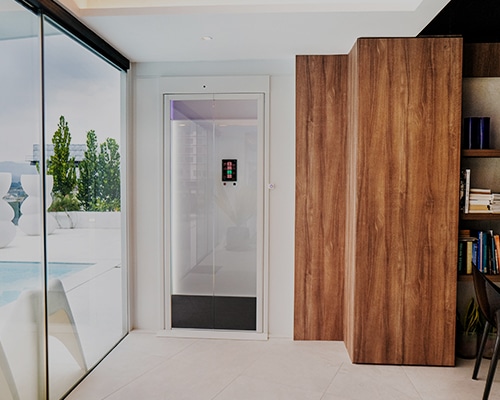
UK homeowners are actively integrating accessibility solutions in their homes. Lifts have become quite common, especially in multi-storey houses, due to the easy accessibility they provide for the elderly or people who need mobility aids. Now, residential lifts can be of several types. This article aims to break down the key differences between through-floor lifts and home elevators to help make informed decisions based on factors such as mobility requirements, property constraints, and financial considerations.
What is a Through Floor Lift?
A through floor lift, as the name suggests, is a type of lift that travels vertically through a floor cutout. Unlike other residential lifts, a through floor lift does not require a complex setup or operation machinery. It is unusually compact and works with a push-button system. It takes up less space and offers excellent mobility assistance for the elderly and impaired. This homelift is a popular choice for smaller spaces. It is a smart choice for accessibility-focused homes or care environments as it works best for properties that demand minimal changes to the existing floor plan.
Advantages-
- It provides accessibility for people with impaired mobility.
- It is wheelchair-friendly
- A through lift is compact and space-efficient compared to traditional home elevators.
- It can potentially increase the property resale value.
Limitations-
- Many customer complain about the design being too much of disability look
- The upfront cost is a bit higher, starting from £15,000 and can go up to £30,000 or more.
- Even if it is less, there are still some structural changes required.
- The Installation can take anywhere from one to three weeks, depending on the kind of modifications required.
What is a Home Elevator?
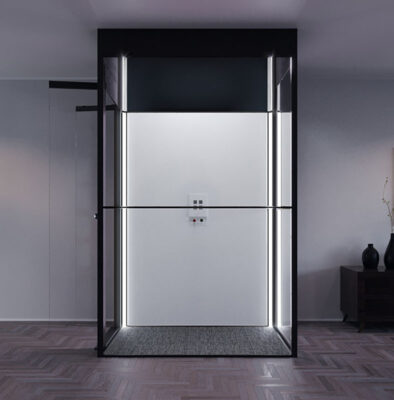
A traditional lift system, home elevators work best for a multi-storey home. It travels across floors, usually within a built-in shaft or enclosure. Unlike the through floor lift, a house elevator requires a more integrated setup. Hence, it is found in larger homes or premium residential projects where space is not a constraint. If integrated smartly and in a planned manner, even a domestic lift can be customised in the house interior.
Advantages-
- It has a higher load capacity.
- A house lift offers a refined user experience.
- It can easily be integrated architecturally in premium homes if planned in advance.
Limitations
- It requires more space than a through floor lift.
- The installation is simple, but still a little bit more advanced than a hole through floor elevator
- The overall cost can go high depending on the model and customisation.
Through Floor Lift vs Home Elevator- A Comparison
Both through floor elevator and the domestic elevator offer excellent mobility assistance, but they differ vastly when it comes to installation, space requirements, cost, and even the long-term impact. Here is a feature-wise comparison between the two types of domestic lifts.
-
Space Requirements
Through Floor Lift:
Perhaps the biggest advantage of a through floor lift is the size. It does not require a shaft, pit, or a separate room for operations. There is no need for major changes to the layout as it can easily fit in a corner or any unused space. Its compact size makes it a great option for UK homes with limited space.
Home Elevator:
On the other hand, a house elevator requires an enclosure for setup, or at the very least a shaft. Even though some modern designs are smaller, the overall space required is more than a floor lift. Hence, it is best suited for multi-storey homes which have ample space or can undergo minor renovations.
-
Accessibility Support
Through Floor Lift:
The primary function of a through floor elevator is to provide mobility solutions to individuals with mobility impairment. Accessibility is at the forefront of this design; to accommodate wheelchair users, mobility aids, and individuals who need a seamless way to move between floors.
Home Lifts:
A homelift also improves accessibility and has a more refined user experience. The kind of load it can carry depends heavily on the cabin size and configuration chosen. Smaller models may not comfortably fit a wheelchair, while larger, fully accessible cabins require more space and structural planning.
-
Cost
Through Floor Elevator:
The pricing lies between £18,000 and £25,000+, depending on the model, features, and the level of work required. Even though it has a high upfront cost, the long-term benefits make it an affordable option than most home lifts.
Home Lifts:
The cost of this domestic lift is a little higher due to the need for a lift shaft, structural alterations, and installation of more advanced machinery. The pricing depends on various factors, like size, design, travel height, and site constraints.
-
Installation
Through Floor Elevator:
Typically, it takes 2 to 3 days to install the system, depending on the property layout and any preparation needed. The process includes the structural changes, cutting open the floor, fitting the system, and any finishing touches.
House Elevator:
A house elevator requires more extensive building work. So, the timeline for this project is longer 5-7 days, especially in older properties that need more electrical upgrades and overall changes.

How to Choose the Right Residential Lift for Your Home?
The choice between a through-floor lift and a home elevator often comes down to understanding the needs of the end user. The decision can be based on the discussed factors, like budget, space, accessibility requirements, and design of the house.
A Through-Floor Lift Works Best When:
- You need the lift specifically for a wheelchair user.
- Accessibility must be long-term and compliant.
- The main travel distance is two floors.
- Two-floor travel is the main requirement.
A Home Lifts Works Best When:
- The property has enough space to accommodate the shaft and other operational machinery.
- There are more than two floors.
- The user wants a more refined and luxurious experience.
- Customization is extensive.
To Sum Up
As the focus of UK homeowners and buyers shifts to accessibility-first properties, finding the right solution is key to making it feel inclusive. Choosing a trusted service provider is as crucial as selecting the right lift model. It ensures that you get value for your money through a quality product and required customizations for the best return on the investment.
FAQ’s
A through-floor lift moves directly between two floors through a cut-out in the floor, making it a compact, accessibility-focused solution mainly for wheelchair users or those with significant mobility needs. A home elevator operates within a shaft and can serve multiple storeys, offering more space, smoother travel, and higher customisation. Essentially, through-floor lifts prioritise accessibility and simplicity, while home elevators deliver a more integrated, premium residential experience.
A through-floor lift is generally the more cheap but limited option, with typical costs ranging from £15,000 to £30,000+. Home elevators usually sit at a higher price point because they require a shaft, more structural work, and often come with premium design options. For clients with tighter budgets or those seeking essential accessibility, a through-floor lift is usually the more cost-effective choice. Home elevators suit projects where budget allows for long-term, multi-storey travel.
Both systems come with robust safety measures, but the features differ based on their design. Through-floor lifts include pressure-sensitive edges, obstruction sensors, and a safety lid that seals the floor opening when the lift moves. Home elevators offer similar protections but may include additional features like interlocked doors, smoother travel mechanics, and enhanced emergency systems. Overall, both meet strict safety standards; the difference lies in configuration rather than safety quality.
A through-floor lift is typically easier to install in most existing UK homes because it doesn’t require a shaft, pit, or machine room. Installation involves cutting a floor opening and reinforcing the structure, usually completed within one to three weeks. Home elevators are more complex, needing a dedicated shaft and significant building work, which extends timelines. For retrofits or minimal disruption, a through-floor lift is the more practical and efficient choice.
Yes, through-floor lifts tend to suit smaller homes better. Their compact footprint and shaftless design make them ideal for UK properties where space is limited. They can be positioned in corners, near stairwells, or in areas that wouldn’t accommodate a full shaft. Home elevators, while more flexible in larger properties, require more room and structural planning. For clients with tight layouts or older homes, through-floor lifts offer far easier integration.
Both through-floor lifts and home elevators need regular servicing to stay safe and reliable. Through-floor lifts typically have simpler mechanics, meaning maintenance is often quicker and slightly more cost-effective. Home elevators, with their shaft systems, doors, and additional electrical components, may require more detailed checks. In both cases, annual servicing is standard, but elevators may need slightly more frequent inspections depending on usage and configuration.
Both lifts can add value, but in different ways. Through-floor lifts increase appeal by improving accessibility, which is valuable for buyers planning long-term living or needing mobility support. Home elevators tend to enhance value in premium or multi-storey homes because they’re seen as a luxury feature. For high-end properties, an elevator may offer a bigger uplift, while through-floor lifts strengthen practicality and broaden the home’s potential buyer base.


