

Most homeowners who start researching mobility solutions for their home begin with the same assumption: a stairlift is the obvious, straightforward answer. And for homes with a single straight staircase, that assumption is often correct.
But for the millions of UK homes with curved, L-shaped, spiral, or winder staircases, the conversation becomes considerably more complicated, considerably more expensive, and considerably more worth examining carefully before committing.
A curved stairlift is a genuinely impressive piece of engineering. It is also one of the most expensive residential mobility products available in the UK market, and the gap between what it costs and what a through floor lift costs is narrower than most people realise. For many UK homeowners, particularly those in properties with multiple floors or staircases that present installation complexity, the through floor lift is not just a comparable alternative. It is the superior long-term investment.
This guide gives you the honest comparison you need to make that decision with confidence.
Why Curved Stairlifts Cost So Much More Than Straight Models
The price difference between a straight stairlift and a curved stairlift is not a matter of a few hundred pounds. It is typically a difference of thousands of pounds, and understanding why helps you evaluate whether the premium is justified for your specific situation.
A straight stairlift uses a standard off-the-shelf rail that is cut to the required length and fitted to the staircase. The rail arrives from a central warehouse, the installation is typically completed in a few hours by a single technician, and the total project time from survey to operational lift is usually one to two weeks. When comparing mobility solutions, understanding elevator benefits such as improved accessibility, ease of use, and long-term independence can also help homeowners evaluate whether alternative options might better suit their needs.
A curved stairlift is an entirely different proposition. Because no two curved staircases are identical in their geometry, the rail for a curved stairlift must be custom-manufactured to match the exact measurements of your specific staircase. This requires a detailed survey by a specialist technician who maps every measurement, every angle, every landing, and every change of direction in the staircase. That survey data is sent to the manufacturer’s production facility, where a bespoke rail is fabricated to match. The manufacturing process typically takes four to eight weeks. Once the rail arrives, installation takes longer than a straight stairlift because of the precision required to fit a custom component correctly.
The cost of this bespoke process is reflected directly in the price. In the UK market in 2026, a straight stairlift for a standard single-flight staircase costs between 1,500 and 3,500 pounds installed. A curved stairlift for a staircase with one or two changes of direction costs between 4,000 and 8,000 pounds installed. For more complex geometries, including tight spiral staircases or multi-landing configurations in older UK properties, costs can reach 10,000 pounds or more.
The UK Curved Stairlift Survey Process
Before any curved stairlift is manufactured, a precise survey must be completed. This is not a quick visit. A specialist surveyor will spend an hour or more measuring every aspect of your staircase: the width at each point, the angle of each tread, the radius of any curve, the height of each landing, the distance from the floor to the ceiling at critical points, and the available wall space for rail fixings.
Many companies charge for this survey, though some offer it without cost as part of the quotation process. What matters more than the survey fee is the accuracy of the resulting measurement data, because the entire bespoke manufacturing process depends on it. An inaccurate survey produces a rail that does not fit correctly, which creates both a delay and a cost to rectify.
The survey also assesses whether your staircase can physically accommodate a curved stairlift at all. Some very narrow spiral staircases, some historically listed buildings, and some properties with unusually low headroom at certain points on the staircase cannot be fitted with a curved stairlift regardless of cost. These situations often lead to the through floor lift being the only practical alternative. In such cases, understanding the different types of lift elevator available for residential use helps homeowners identify safer and more suitable accessibility solutions for their property.
The Real Price Comparison: Curved Stairlift vs Through Floor Lift
This is the comparison that most homeowners do not receive clearly, because most stairlift suppliers do not offer through floor lifts, and most through floor lift suppliers do not offer stairlifts. Objectivity is rare in this market.
A through floor lift, sometimes called a vertical platform lift or home lift, creates a straight vertical pathway through the floor structure between two levels. A platform or enclosed cabin travels through an opening cut in the floor between levels. For the passenger, the experience is similar to using a small elevator: they enter the cabin, press a button, and arrive at the next level with no physical effort and no staircase involved.
Swift Lifts through floor lift installations for a standard two-floor UK property have total installed costs that typically fall between 12,000 and 22,000 pounds depending on the cabin size, the configuration, and the specific civil works required by the floor construction. This is higher than the cost of a curved stairlift in most cases.
However, the ten-year total cost of ownership comparison tells a different story.
Comparison Table: Curved Stairlift vs Through Floor Lift in the UK
| Factor | Curved Stairlift | Through Floor Lift (Swift Lifts) |
| Initial installed cost | £4,000 to £10,000+ | £12,000 to £22,000 |
| Annual maintenance | £200 to £500 | £300 to £600 |
| Service life | 10 to 15 years | 20 to 25 years |
| Wheelchair accessible | No | Yes (L/XL cabin) |
| Staircase usability for others | Reduced | Unaffected |
| Property value impact | Neutral to slight negative | Neutral to positive |
| Multi-floor capability | One flight per unit | All floors, one installation |
| DFG grant eligibility | Yes | Yes |
| Battery backup | Varies | Yes (Swift EcoDrive) |
The through floor lift has a higher purchase price. What it delivers in return is service across a far longer product lifespan, full wheelchair accessibility, no compromise to staircase usability for other household members, and a single installation that serves all floors rather than requiring a separate unit for each staircase in a multi-floor home.
When a Curved Stairlift Is the Right Choice
A curved stairlift is genuinely appropriate in specific circumstances, and it is worth being clear about what those circumstances are.
If the primary user is a single person who has good ability to transfer themselves onto and off the lift seat, who is unlikely to progress to wheelchair use, who lives in a two-floor property with a single curved staircase, and for whom the budget genuinely cannot stretch to a through floor lift even accounting for DFG grant assistance, a curved stairlift from a reputable supplier addresses the immediate need effectively. However, when evaluating long-term options, it is also important to compare home lift price alongside stairlift costs, as the initial investment and lifetime value can significantly influence the most practical accessibility decision.
It is also worth noting that for some UK properties, particularly period houses and listed buildings where floor modifications are restricted by conservation requirements, a curved stairlift may be the only option that the local planning authority will permit. In these situations, the choice is not between a stairlift and a through floor lift. It is between a stairlift and nothing.
When a Through Floor Lift Is the Smarter Choice
The through floor lift becomes the clearly superior decision in several common UK residential scenarios.
For a home with three or more floors, a curved stairlift addresses only one staircase. If the home has two separate staircases between floors, two curved stairlift installations would be required, bringing the combined cost to 8,000 to 20,000 pounds or more for two units, alongside two separate annual maintenance costs and two separate service relationships. A single Swift Lifts through floor lift installation serves all floors simultaneously at a total installed cost that, in this context, compares very favourably.
For a wheelchair user or anyone likely to progress to wheelchair use, a curved stairlift provides no benefit at all. The passenger must transfer from their wheelchair to the stairlift seat, travel to the next floor, and transfer back. For many wheelchair users this transfer is not independently achievable, and the wheelchair cannot accompany them to the destination floor. A through floor lift with a wheelchair-accessible L or XL cabin size carries the user and their wheelchair between floors without any transfer, enabling genuine independence.
For families where other household members need to use the staircase freely and regularly, a curved stairlift rail running the length of the staircase reduces the available width. In narrower UK staircases common in Victorian terraces, this reduction can make the staircase feel genuinely constrained for other users. A through floor lift leaves the staircase completely unchanged.
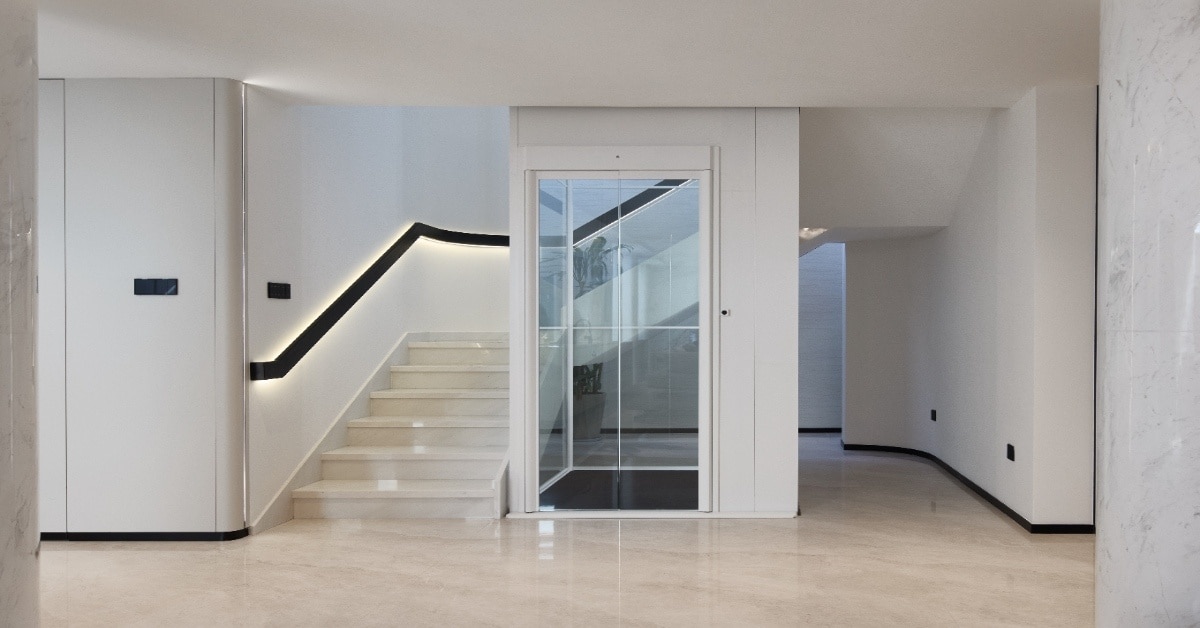
For homeowners who value the design quality of their interior, a curved stairlift rail permanently alters the visual character of the staircase. A Swift Lifts through floor lift with a glass configuration can actually enhance the interior aesthetics of a well-designed UK home, becoming an architectural feature rather than a functional intrusion.
DFG Grant Eligibility and Funding in the UK
The Disabled Facilities Grant is a means-tested government grant available to homeowners and tenants in England, Wales, and Northern Ireland who need to adapt their home due to disability. Both curved stairlifts and through floor lifts can qualify for DFG funding, subject to eligibility assessment. In addition to improving accessibility, solutions like a through floor lift are often designed to reduce lift energy consumption through modern efficient drive systems and standby modes, helping make long-term operation more cost-effective.
The maximum DFG grant in England is currently 30,000 pounds, which is more than sufficient to cover a significant proportion of a through floor lift installation for eligible applicants. The grant is administered by local councils and requires an Occupational Therapist assessment to confirm that the proposed adaptation is necessary and appropriate.
The application process begins with contacting your local council’s housing or adaptation service. An OT assessment follows, after which the council’s adaptation service confirms eligibility and the approved grant amount. For higher-cost adaptations, the council may also carry out a means test to determine whether any contribution from the homeowner is required.
Swift Lifts works with DFG applicants across the UK to provide the technical documentation, product specifications, and detailed quotations required for successful grant applications. The process takes time, typically several months from initial application to grant approval, but for eligible homeowners it can reduce the net cost of a through floor lift installation significantly or eliminate it entirely.
Impact on Home Resale Value
The effect of a stairlift or through floor lift on UK property value is a question that estate agents and homeowners discuss with varying degrees of certainty, and the honest answer is more nuanced than either “it adds value” or “it reduces value.”
A curved stairlift rail permanently fixed to a staircase has a neutral to slightly negative effect on resale value for buyers who do not need it. Removing a curved stairlift rail leaves fixing marks on the stairs and wall that require remediation. Most buyers in the general market will perceive a stairlift as a signal that the property requires adaptation, which affects their perception of the home regardless of whether they personally need the equipment.
A through floor lift from Swift Lifts is assessed differently by the market. In the upper segment of the UK residential market, a glass through floor lift is increasingly seen as a premium feature that adds to the perception of quality in the home. For buyers who anticipate needing accessibility features, it is a significant positive. For buyers who do not, it is typically neutral in value terms and more easily absorbed into the design of the home than a stairlift rail.
Warranty Considerations
Curved stairlift warranties in the UK typically cover the chair and drive mechanism for one to two years on a standard basis, with extended warranty options available at additional cost. The bespoke rail is generally covered for a shorter period reflecting the manufacturing basis of the component. Annual servicing is required to maintain warranty validity. When considering long-term performance and reliability, lift modernisation can also play an important role in improving safety, efficiency, and extending the usable life of accessibility systems in residential properties.
Swift Lifts through floor lifts carry a five-year comprehensive warranty covering parts and labour across all systems including the drive mechanism, safety systems, door operation, and control electronics. The warranty is not conditional on purchasing extended cover and is backed by a local UK service team. For a product with a 20 to 25-year expected service life, the depth of warranty coverage in the early years is a meaningful differentiator.
Frequently Asked Questions
How much does a curved stairlift cost in the UK compared to a straight stairlift?
A straight stairlift in the UK costs between 1,500 and 3,500 pounds installed. A curved stairlift costs between 4,000 and 10,000 pounds or more, depending on the complexity of the staircase geometry. The premium reflects the bespoke rail manufacturing process, the detailed survey requirement, and the longer installation time involved.
Can any stairlift company fit a curved stairlift on any staircase shape?
Not all staircase shapes can be fitted with a curved stairlift. Very tight spiral staircases, staircases in listed buildings with conservation restrictions, and some properties with insufficient clearance at specific points cannot accommodate a curved stairlift regardless of the manufacturer. In these situations, a through floor lift is typically the only practical alternative.
Is a through floor lift cheaper than a curved stairlift over 10 years?
The through floor lift has a higher initial purchase price. However, over ten years when annual maintenance, the likely need for curved stairlift replacement at the end of its service life, and the superior functionality of the through floor lift are factored in, the total cost of ownership comparison is much closer than the initial prices suggest. For a three-floor property requiring multiple stairlift installations, a single through floor lift is typically cheaper in total cost terms over ten years.
How long does it take to install a curved stairlift in the UK?
From initial survey to operational installation, a curved stairlift typically takes four to eight weeks in the UK due to the bespoke rail manufacturing process. The installation itself takes one to two days once the rail is available. A Swift Lifts through floor lift has a lead time of six to ten weeks from order confirmation to installation, with the active on-site installation period being three to five working days.
Does a curved stairlift affect the value of my home?
A curved stairlift has a neutral to slightly negative effect on resale value for buyers who do not require it, primarily due to the visual presence of the rail and the remediation required if the unit is removed. A quality through floor lift from Swift Lifts is typically neutral to positive in value terms and integrates more naturally into the home’s design, particularly in glass configurations.
The Decision That Serves Your Home Long Term
Choosing between a curved stairlift and a through floor lift is ultimately a question of time horizon and scope. If the need is immediate, budget is constrained, the user has good transfer ability, and the home has a single curved staircase serving two floors, a curved stairlift from a reputable supplier is a reasonable solution to a defined problem.
If the need is for a genuine long-term accessibility solution that serves every household member, works for wheelchair users, leaves the staircase unaffected, and represents an investment in the home rather than simply an adaptation of it, the Swift Lifts through floor lift is the choice that delivers on all of those requirements with the engineering quality, comprehensive warranty, and UK service capability to support it.
Contact Swift Lifts UK for a free home assessment and transparent cost comparison. Whether you are beginning a DFG application, planning an adaptation for an elderly family member, or simply researching your options, the conversation costs nothing and the clarity it provides is worth considerably more.


