

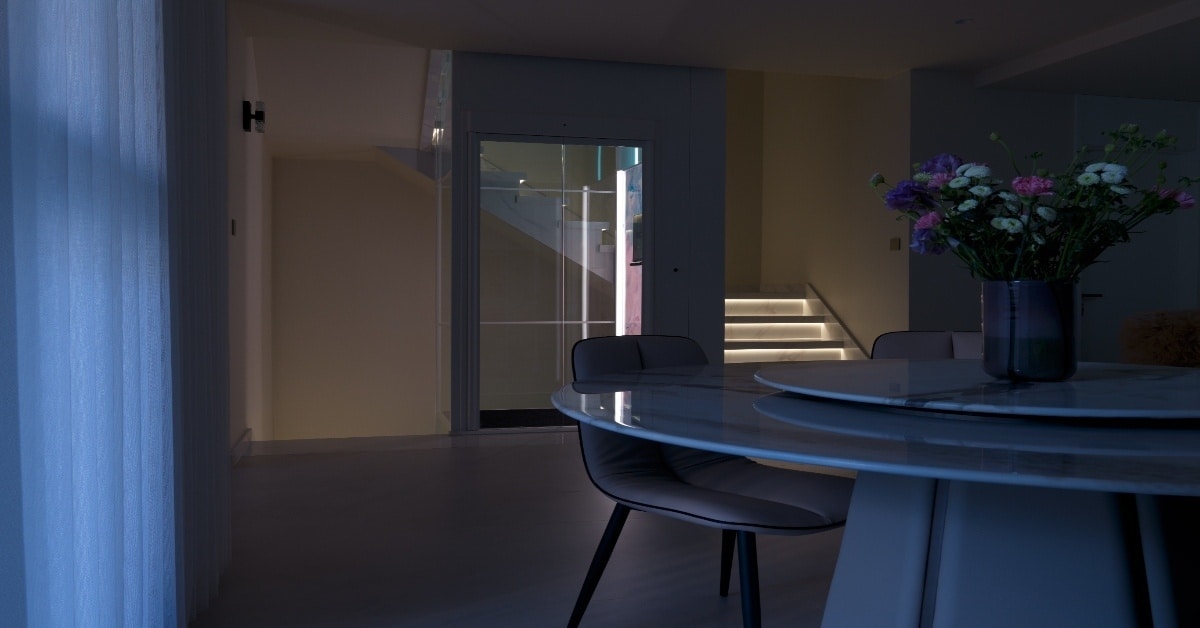
Australia’s housing stock was not designed with wheelchair users in mind. The vast majority of homes built across Sydney, Melbourne, Brisbane, Perth, and Adelaide before 2010 have stairs, steps at entry points, split levels, and floor transitions that create genuine barriers for anyone using a wheelchair or mobility aid.
For Australian families navigating disability, ageing, or the aftermath of injury, the gap between where a person lives and how well that home actually works for them is a daily reality.
The wheelchair platform lift has become one of the most effective solutions to this gap. It is not a complex or intrusive piece of infrastructure. In its modern form it is a compact, certified, and elegantly engineered device that enables independent movement between floor levels in a private home, giving wheelchair users back the access and dignity that architectural barriers take away.
This guide explains what a platform lift actually is, how it works in the context of an Australian home, what the regulations require, what NDIS funding makes possible, and what the realistic costs look like in 2026 when all elements of a proper installation are accounted for.
What Is a Wheelchair Platform Lift and How Does It Work?
A platform lift, also referred to as a vertical platform lift or wheelchair lift, is a powered lifting device that carries a person on a platform or within an enclosed cabin between two or more floor levels. Unlike a passenger elevator in a commercial building, a residential platform lift is designed specifically for the space constraints, load requirements, and usage patterns of a private home.
The mechanism varies between product types. Some platform lifts use a screw-drive system where a motorised spindle turns to raise and lower the platform. Others use a hydraulic mechanism or a belt-driven system. Swift Lifts platform lifts use a proprietary drive system combined with EcoDrive regenerative battery technology, which recharges the battery during the descent cycle. This approach makes the lift genuinely energy-efficient in daily use and provides reliable battery backup that keeps the lift operational during the power interruptions that occur across Australian residential areas.
The platform or cabin sits within a structural enclosure that is either built into the fabric of the home as a masonry shaft or provided by the manufacturer as a self-supporting modular structure. In most Australian home installations, particularly retrofit situations in existing homes, the modular self-supporting structure is the practical choice because it eliminates the need to build a masonry shaft from scratch, reduces the civil works involved, and allows installation to be completed within a matter of days rather than weeks.
The lift is operated by the user from within the platform or cabin using controls positioned at an accessible height and designed for operation by a person with limited hand strength or dexterity. An independent call and send function at each floor allows the lift to be called from outside as well as operated from within, which matters enormously in a home where a wheelchair user moves independently through the house without always having assistance available.
Australian Regulations for Home Accessibility Lifts
The primary technical standard applicable to residential platform lifts in Australia is AS 1735.17, which governs the design, manufacture, and installation of inclined and vertical platform lifts used for persons with disabilities. This standard specifies minimum platform dimensions, load ratings, maximum travel speeds, door and gate safety requirements, emergency systems, and installation inspection requirements. A product installed in an Australian home that does not comply with AS 1735.17 is not legally certified for use and may affect the homeowner’s insurance coverage and liability position.
Building approval requirements for platform lift installation vary between states. In most Australian states, installing a platform lift in an existing dwelling requires a building permit or development approval from the local council or certifier. The specific requirements depend on whether the installation involves structural modifications to the building, the type of enclosure used, and in some cases the heritage or zoning status of the property. A compliant supplier like Swift Lifts coordinates the building approval process as part of the installation project, ensuring that the homeowner does not need to navigate the approvals framework independently.
The Disability Discrimination Act 1992 establishes the legal framework for accessibility in Australia, and while it applies primarily to public buildings and services, its principles inform the expectations of what constitutes reasonable accessibility provision in residential contexts, particularly in the context of NDIS planning and supported independent living arrangements.
Certification of the completed installation is mandatory. After a platform lift is installed in an Australian home, it must be inspected and certified by a licensed lift inspector before it enters regular use. This inspection verifies that the installation meets AS 1735.17 requirements and that all safety systems function correctly. The certification certificate should be retained permanently as part of the property records.
NDIS Funding for Wheelchair Lifts in Australian Homes
The National Disability Insurance Scheme is one of the most significant considerations for Australian wheelchair users and their families when evaluating home accessibility modifications, including platform lift installation. Understanding how NDIS funding applies to wheelchair lifts is essential for making an informed decision about the most cost-effective path forward.
Platform lifts for home accessibility are classified under the NDIS as Capital Supports within the Assistive Technology or Home Modifications categories depending on the specific nature of the installation and the participant’s plan. Home modifications that enable a person with disability to access and navigate their home independently are a recognised and commonly funded support type under the NDIS.
For a wheelchair platform lift installation to be funded through an NDIS plan, several conditions typically apply. The installation must be assessed as reasonable and necessary for the participant to achieve their functional goals and live as independently as possible. This assessment is usually conducted by an Occupational Therapist who evaluates the participant’s home environment, their functional requirements, and the specific modifications that would address the identified barriers. The OT report forms the basis of the NDIS funding request and is a critical document in the approval process.
Higher-cost home modifications, which most platform lift installations qualify as given their cost levels, require a quote from a registered provider and often require approval from the NDIA before work commences. Working with a supplier who is familiar with NDIS processes and can provide the documentation required for a funding application significantly simplifies this process for participants and their families.
Swift Lifts works with NDIS participants and their support coordinators across Australia to provide the detailed quotations, technical specifications, and product documentation required to support home modification funding applications. The process of obtaining NDIS funding for a platform lift is not simple or fast, but with the right support it is entirely navigable, and for eligible participants it can cover a substantial proportion or the full cost of the installation.
State and territory government home modification grant programmes also exist alongside the NDIS and may be available to older Australians or people with disability who are not NDIS participants. These programmes vary significantly between jurisdictions, and a Swift Lifts consultant can advise on the programmes applicable in your state as part of the initial consultation.
Platform Lift vs Stair Lift for Wheelchair Users: Understanding the Difference
This comparison comes up frequently in Australian consultations, and the distinction matters enormously for wheelchair users specifically.
A stair lift carries a seated user along a rail mounted to the existing staircase. The user must transfer from their wheelchair to the stair lift seat at the bottom of the stairs and transfer back to the wheelchair at the top. For a person who uses a manual wheelchair and has good upper body strength, this transfer is possible though demanding. For a power wheelchair user, or for anyone who cannot independently transfer between seating positions, a stair lift is not a viable solution. The wheelchair stays on one floor while the person travels to another, which means the wheelchair must be present on both floors or the user must manage without it at the destination level.
A platform lift carries the wheelchair user while they remain in their wheelchair throughout the journey. There is no transfer required. The user wheels onto the platform or into the cabin, the door closes, and the lift carries them and their wheelchair to the destination floor. They wheel off the lift and continue moving through the home independently. This is genuine independence rather than an adaptation that requires assistance or creates dependency at the transition points.
For a power wheelchair user, a platform lift is not simply the better option. It is the only option that enables fully independent vertical mobility within the home. Power wheelchairs are heavy, often exceeding 100 to 150 kilograms including the user, and cannot be transferred by the user in the same way a manual chair can be folded and repositioned. A platform lift with an appropriate weight capacity rating is the only residential mobility solution that accommodates power wheelchair users completely.
Swift Lifts L and XL cabin sizes provide the floor area and door width required for standard power and manual wheelchair access. The 800 millimetre clear door width and the 1100 by 1400 millimetre cabin floor area of the XL model meet the dimensional requirements for independent wheelchair use as specified under Australian accessibility guidelines, with turning radius space that allows the user to position themselves and their chair comfortably within the cabin.
Cost Breakdown for Platform Lift Installation in Australian Homes
The cost of installing a wheelchair platform lift in an Australian home varies based on several factors that interact to produce the final project cost. Understanding these factors helps homeowners and NDIS participants build an accurate budget and evaluate quotations from different suppliers.
For a two-level installation in a standard Australian home, the total installed cost of a quality wheelchair platform lift from Swift Lifts ranges from approximately 18,000 to 32,000 Australian dollars depending on the cabin size, configuration, and the specific civil works required. This figure includes the lift equipment, the modular structural enclosure, the floor opening preparation, electrical connection, and the mandatory certification inspection.
For a three-level installation, the total typically runs from 25,000 to 42,000 dollars. Each additional level adds the cost of the extended structural enclosure, an additional floor opening, and additional electrical and finishing works.
The civil works component is a meaningful part of the total cost and is worth understanding in detail. In an existing Australian home, the floor opening preparation involves cutting through the floor structure at each level the lift serves. In a timber frame home on a suspended floor, this is a relatively contained structural modification. In a concrete slab construction, diamond-tipped saw cutting equipment is used and the structural assessment of the slab edge reinforcement is an engineering task. Swift Lifts includes a structural assessment as part of the site survey and provides a complete itemised quotation that covers all civil works.
The electrical connection for a platform lift in an Australian home typically requires a dedicated 240-volt circuit from the consumer board, which is standard residential wiring work. If the consumer board does not have a spare circuit position available, a board upgrade may be required, which adds to the electrical cost.
Annual maintenance for a Swift Lifts platform lift in Australia under a service contract costs approximately 400 to 700 dollars per year depending on usage level and location. The mandatory recertification inspection required by Australian regulations every two years costs approximately 200 to 400 dollars. Over a ten-year ownership period, total maintenance and certification costs of 5,000 to 9,000 dollars represent a realistic planning figure.
Practical Installation Considerations for Australian Homes
Swift Lifts conducts free site surveys across Australia. The survey confirms the available space for the lift at each level, assesses the floor construction type and the structural implications of the required openings, measures the overhead clearance at the proposed top level landing, confirms the electrical supply situation, and identifies any access or logistics considerations specific to the property. For properties in metropolitan areas including Sydney, Melbourne, Brisbane, Perth, and Adelaide, site surveys are typically available within one to two weeks of initial contact.
The minimum floor opening for the Swift Lifts XL cabin, the recommended wheelchair-accessible configuration, is 1100 by 1400 millimetres. This opening must be achievable at every floor the lift serves, which means a vertical alignment of this dimension through the floor plan of the home must be identified. In the majority of Australian homes, this alignment can be found in a corner of a room, alongside an internal wall, or within a reconfigured storage space. The site survey confirms the alignment options and their design implications.
Overhead clearance of 2275 millimetres above the top floor landing is required for Swift Lifts models. Standard Australian residential ceiling heights of 2.4 to 2.7 metres meet this requirement in most homes built since the 1980s. Homes with lower ceiling heights at the planned top landing may need to adjust the lift position or explore the structural implications of raising the ceiling in that area.
The pit depth required by Swift Lifts is just 50 millimetres, which is managed through a small floor build-up at the ground level entry point rather than excavation below the existing slab. This is a significant practical advantage for Australian homes built on concrete slabs, which represent the majority of residential construction in most Australian cities, because it eliminates the excavation that traditional lift installation would require.
Frequently Asked Questions
Yes, NDIS funding can be used to fund wheelchair platform lift installation in an Australian home under the Home Modifications category of Capital Supports. The process requires an Occupational Therapist assessment that identifies the functional barriers in the home and recommends the platform lift as a reasonable and necessary modification to address those barriers. A quote from a registered provider, which Swift Lifts can supply with full technical specifications, supports the funding application. Higher-cost modifications typically require pre-approval from the NDIA before work commences. Swift Lifts works with NDIS participants, their support coordinators, and OT teams across Australia to provide the documentation required for successful home modification funding applications. If your current plan does not include sufficient allocation for a home modification of this scale, a plan review request supported by OT assessment and supplier documentation is the pathway to securing the funding.
A stair lift carries a seated user along the existing staircase, which requires the user to transfer from their wheelchair to the stair lift seat and back again. For many wheelchair users, particularly power wheelchair users, this transfer is not independently achievable and the wheelchair cannot accompany them to the destination floor. A platform lift carries the wheelchair user while they remain in their wheelchair throughout the journey, with no transfer required. The user wheels onto the platform, rides to the destination floor, and wheels off independently. For full independence without requiring transfer assistance, a platform lift is the only residential solution that works for wheelchair users of all chair types and mobility profiles. Swift Lifts XL cabin dimensions accommodate standard power and manual wheelchairs and meet Australian accessibility guidelines for independent wheelchair use.
The Right Solution for Your Home and Your Situation
Every Australian home is different, and every wheelchair user’s situation has its own specific requirements. The right platform lift for a compact Brisbane townhouse is a different specification from the right solution for a split-level Perth home or a double-storey Sydney property. Getting the specification right requires a conversation that starts with your home, your daily functional requirements, and your funding situation rather than with a product catalogue.
Swift Lifts Australia provides free consultations and site assessments that take the time to understand your specific situation before making any recommendation. The Swift Lifts platform lift range covers the full spectrum of Australian residential wheelchair accessibility needs, from compact two-level installations to multi-level villa configurations, all certified to AS 1735.17 and all backed by a five-year comprehensive warranty and an Australian service network.
The combination of Scandinavian engineering precision, EcoDrive battery backup reliability, and genuine local Australian service capability makes Swift Lifts the supplier that Australian families with real accessibility needs consistently choose when the decision is made carefully and with full information.
Contact Swift Lifts Australia today to arrange your free site assessment and consultation. Whether you are beginning the NDIS funding process, planning a home modification, or simply trying to understand what is possible in your home, the conversation costs nothing and the clarity it provides is worth considerably more.


