

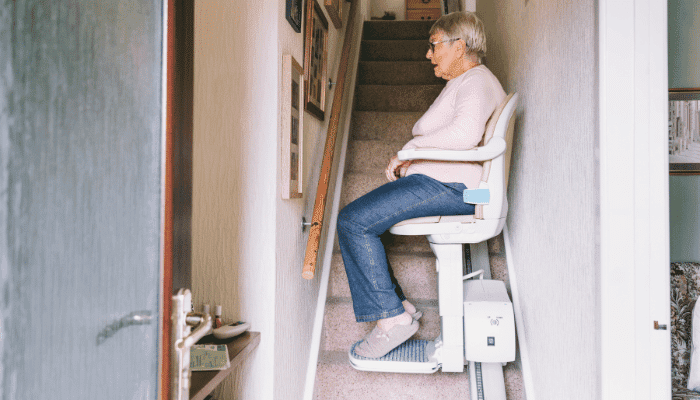
That’s the reality for millions of Indian families today. Our parents are aging in homes designed for younger bodies. The question isn’t whether they need help with stairs. The question is which solution actually works for Indian families long term.
The Problem Most Indian Families Face
Walk into any Indian home with elderly parents and you’ll see the same pattern. The parents sleep on the ground floor now, even though their actual bedroom is upstairs. Or they’re still climbing stairs daily, but it takes longer each month, and everyone worries. Or there’s a full-time helper whose main job is assisting with stairs four to six times per day.
Knee pain and arthritis don’t come suddenly. They develop gradually, and families adjust gradually, until one day you realize your 68-year-old mother hasn’t been to the first floor in three months. She’s living in what used to be the guest bedroom, disconnected from the space that’s been hers for decades.
The medical reality is straightforward. Osteoarthritis affects nearly 60% of Indians over 65. Knee replacements are common, but recovery takes months and stairs remain difficult afterward. Hip problems, diabetes-related weakness, heart conditions that make exertion risky, high blood pressure that spikes with physical strain. All of these make stairs genuinely dangerous for elderly parents.
Falls on stairs represent one of the leading causes of serious injury in elderly Indians. A fractured hip at 72 years old often means months of bed rest, rapid muscle loss, and a permanent reduction in mobility and independence. The medical costs regularly exceed ₹8-10 lakhs when you factor in surgery, hospitalization, and rehabilitation. The emotional cost, watching your parent lose confidence and independence after a fall, doesn’t have a price tag.
Why Standard Solutions Don’t Work Well
Indian families typically try several approaches before considering a home lift for senior citizens. Understanding why these don’t work helps clarify what does.
Moving parents downstairs seems simple initially. But you’re taking your mother out of the bedroom she’s occupied for twenty or thirty years, the space with her belongings arranged exactly as she likes, the morning routine she’s built, the sense of home and ownership. You’re moving her into what’s often a smaller ground floor room, maybe the one facing the road with traffic noise, or the back room without proper ventilation. That loss of familiar space affects elderly people more than families realize. Depression, sleep disturbances, and a sense of displacement are common.
Full-time caretaker assistance costs ₹18,000 to ₹30,000 monthly in most cities. That’s ₹2.5 to ₹4 lakhs annually. But the bigger issue is independence. Your parent now depends on someone else’s schedule and availability to move between floors. They can’t go upstairs spontaneously to get something from their cupboard or sit on the terrace in the evening. Every movement requires asking for help, waiting for availability, feeling like a burden. That chips away at dignity and autonomy daily.
Stairlifts work for some situations but have significant limitations in Indian homes. Most Indian houses have L-shaped or U-shaped staircases with turns and landings. Stairlifts for these configurations require custom curved rails costing nearly as much as a proper lift. Even then, the stairlift occupies your entire staircase permanently. Other family members squeeze past it. You cannot carry anything substantial up or down. Only one person uses it, only when sitting in the chair. During festivals when the whole family is moving between floors with food, decorations, and guests, that stairlift becomes an obstacle.
Ramps occasionally work for single-floor homes or small elevation changes but are impractical for standard Indian floor heights. A safe ramp gradient requires roughly 12 feet of length for every 1 foot of height. For a typical 10-12 foot floor height, you’d need a 120-140 foot ramp snaking through your home. That’s not realistic for residential properties.
What Makes a Lift Right for Elderly Users
Not every residential lift for parents serves elderly needs equally. The features that matter for a 35-year-old using a lift occasionally differ completely from what a 72-year-old with arthritis and vision issues needs for safe daily operation. Understanding the lift price in Delhi NCR helps families plan effectively for a solution that balances cost, safety, and long-term usability for senior residents.
Control panel design starts with the basics. Large, clearly labeled buttons with good contrast and backlighting. Raised or textured surfaces that elderly fingers can feel, not smooth touchscreens that require precise tapping. Button placement at a comfortable height for someone sitting in a wheelchair or using a walker. These details seem minor until your parent with shaky hands and reading glasses tries to operate a lift with tiny buttons in dim lighting.
Door operation needs to be fully automatic with intelligent sensors. Elderly users shouldn’t push or pull doors. The lift should handle everything. Obstruction sensors must prevent doors from closing if anything blocks them, even a walking stick or the edge of a saree. SWIFT lifts use dual automatic doors on opposite cabin sides, allowing elderly users to enter and exit without turning around, critical for anyone with balance issues or mobility aids.
Cabin interior requires sturdy handrails on three sides positioned at heights comfortable for both standing and sitting users. Anti-slip flooring that works even with wet footwear during monsoons. Adequate lighting without harsh glare. Enough space for a wheelchair, walker, or someone with a caretaker, typically 3.5 by 4 feet minimum.
Speed and acceleration matter differently for elderly passengers. The lift should move smoothly without jerky starts or sudden stops that could make someone lose balance. A one floor lift for elderly users doesn’t need to be fast. Gentle, predictable movement with 15-20 second travel time between floors is ideal. SWIFT’s engineering prioritizes smooth acceleration curves specifically for senior citizen comfort and safety.
Emergency communication during power cuts or medical situations separates reliable lifts from problematic ones. SWIFT includes emergency alarm buttons connecting to 24-hour support and integrated intercom systems letting elderly users speak directly with family members on other floors without needing to handle a mobile phone. If your 75-year-old father feels chest pain or dizziness while in the lift, that direct communication line becomes critical.
Battery backup during power failures is absolutely essential in India where outages still happen regularly. Your elderly parent should never get trapped inside during a power cut. SWIFT lifts include battery systems providing 4 to 6 complete trips during extended outages. Even in the worst-case scenario of getting stuck, the battery powers cabin lighting, ventilation, and communication systems until power returns or help arrives.
Comparing Lift Options for Indian Homes
The market offers several residential lift types. Understanding differences helps families make informed decisions.
Hydraulic lifts use oil-based systems with pistons and require machine rooms. They’re common in commercial buildings but less suitable for Indian homes. They consume more power, require more maintenance, and the hydraulic fluid can leak over time. Installation is complex and expensive.
Traction lifts use steel ropes or belts with counterweights. They’re efficient and common in residential buildings but still require substantial structural work and often need machine rooms or significant overhead space.
Screw-driven and platform lifts represent newer technology designed specifically for residential use. These are what companies like SWIFT specialize in for Indian homes. They require minimal structural modification, no separate machine room, and can be installed in 4-7 days. The mechanisms are enclosed, safe, and designed for the daily wear patterns of home use, not commercial buildings.
For elderly users specifically, screw-driven residential lifts offer the best combination of safety, reliability, smooth operation, and ease of installation without major home renovation. They work quietly, require minimal maintenance, and deliver the gentle acceleration elderly passengers need. For compact Indian homes, a small lift for home India provides these benefits while fitting into tight spaces and addressing local power and space constraints.
The Real Investment in Your Parents’ Independence
Let’s discuss costs honestly because this decision affects your family’s finances significantly.
Budget residential lifts from local manufacturers start around ₹6-8 lakhs for basic two-floor installations. These serve a market segment but come with limitations: shorter warranties, slower service response, components that may not last beyond 7-8 years, and safety features that meet minimum standards without exceeding them.
SWIFT Lite begins at ₹19,00,000 plus taxes for ground plus one floor. SWIFT Pro starts at ₹20,00,000 plus taxes for the same configuration. That’s substantially higher than budget alternatives. Here’s what you’re actually paying for:
German engineering standards applied to equipment designed for Indian conditions. Components and safety systems built for 20-year lifespans, not 7-year replacements. Service networks across Indian cities with trained technicians who respond quickly when your elderly parent depends on this equipment daily. Comprehensive warranties that actually cover repairs without endless exclusions. Build quality where the lift operates as smoothly and reliably in year 15 as it did in year 1.
Most importantly, you’re installing this for your parents’ safety and independence. Choosing a budget option that needs replacement in eight years means your family goes through the disruption and expense twice. Your parent who’s 68 today will be 76 when that budget lift fails, potentially less able to handle the stress of replacement installation. Many homeowners also consider lift direction as per vastu to ensure the elevator’s placement supports positive energy flow and harmony in the home while maintaining safety and usability.
Understanding the Full Cost Comparison
Before dismissing ₹19-20 lakhs as expensive, calculate what you’re comparing it against over time.
Full-time caretaker assistance costs ₹18,000 to ₹30,000 monthly for someone primarily helping with stairs and mobility. That’s ₹2.5 to ₹4 lakhs annually. Over eight years, you spend ₹20 to ₹32 lakhs, more than the lift costs, and you still don’t have a permanent solution. Your parent still lacks independence, still depends on someone else’s availability and mood.
Medical expenses from fall-related injuries in elderly people regularly exceed ₹8-12 lakhs. Hip fracture surgery, hospitalization, ICU stay if there are complications, months of physiotherapy, home nursing care during recovery. One serious fall can cost more than the lift while causing trauma and permanent mobility reduction that money cannot fix.
Modification costs for accessibility add up surprisingly fast. Rearranging ground floor rooms, adding bathrooms, installing grab bars throughout, widening doorways for wheelchairs. Families often spend ₹3-5 lakhs making a ground floor livable for elderly parents, and the parents still lose access to half their home.
A home lift preserves independence and dignity while eliminating daily physical risk. It also increases property value substantially. When you eventually sell, a well-maintained SWIFT lift becomes a significant advantage as more buyers include elderly parents in their household or plan for their own aging in place.
Installation and Daily Reality
SWIFT installations typically complete in 4 to 7 days depending on your home’s specific structure. The team works systematically: ground floor shaft construction, first floor shaft, then lift mechanism and cabin installation. Your family can continue living at home during installation, though expect some construction noise and dust during civil work.
The space requirement is manageable for most homes: approximately 9-12 square feet per floor for the vertical shaft, commonly placed adjacent to existing staircases or in underutilized corners.
Once installed, daily operation becomes routine. Your elderly parent presses a large, backlit button, doors open automatically, they enter and press their destination floor, doors close gently, smooth travel takes 15-20 seconds, doors open at destination. The entire process requires no physical strength, no bending, no risk of losing balance.
Power consumption stays economical at approximately 1 to 1.5 units daily with regular residential use. Monthly electricity costs increase by ₹200-300, negligible compared to the benefit delivered.
Maintenance requirements for senior-friendly lifts are straightforward. SWIFT recommends annual servicing where technicians inspect safety systems, lubricate moving parts, check electrical connections, and verify everything operates within specifications. This annual maintenance typically costs ₹8,000 to ₹12,000 depending on location and any parts requiring replacement. Beyond this annual service, the lifts generally run trouble-free for years.
Making This Decision for Your Family
If your elderly parents struggle with stairs now, or you see that struggle developing, a lift for elderly at home represents the most practical long-term solution available to Indian families today. For smaller residences or one-story homes, a single floor home lift provides a safe, cost-effective option that meets mobility needs without major structural changes.
It costs more initially than moving parents downstairs, hiring help, or trying makeshift solutions. But it delivers something those alternatives cannot: genuine independence, safety, and dignity for your parents as they age in their own home.
The best time to install is before an emergency forces the decision. Install while your parents can still manage stairs, just with difficulty. That lets you plan properly, choose optimal placement, select the right model, and make financially informed decisions rather than panic-buying after a fall or hospitalization.
Start with a proper home assessment. SWIFT provides consultations where technical teams evaluate your space, explain what’s structurally possible, discuss features relevant to your parents’ specific needs, and provide transparent cost estimates. There’s no pressure, just information so you can decide intelligently.
I’ve watched these lifts transform daily life for elderly parents across India. The 70-year-old who can now visit her terrace garden every evening. The 75-year-old grandfather who goes upstairs to his library whenever he wants. The 68-year-old mother who regained her bedroom and morning routine. Those aren’t luxury upgrades. Those are quality of life improvements that let your parents age with independence and dignity in the home they’ve built.
Your parents raised you, provided for you, and gave you the foundation you stand on today. Giving them safe, independent mobility in their own home as they age isn’t extravagance. It’s respect, care, and practical wisdom.
Frequently Asked Questions
The best lift for elderly people at home combines safety features, ease of operation, and reliability. Look for automatic doors with obstruction sensors, large backlit control buttons, smooth acceleration without jerky movements, battery backup for power cuts, emergency communication systems, anti-slip flooring, handrails on three sides, and space for wheelchairs or walkers. SWIFT’s residential lifts are specifically designed for elderly users with German engineering standards, dual automatic doors, 4-6 trip battery backup, and control panels easy to operate with arthritis or vision issues. Screw-driven residential lifts work better than hydraulic or traction systems for homes, requiring less maintenance and delivering smoother rides.
Yes, quality home lifts remain safe during power cuts through integrated battery backup systems. SWIFT lifts include batteries providing 4 to 6 complete trips during extended power failures, ensuring elderly users never get trapped inside during outages. Even if battery power depletes, the backup maintains cabin lighting, ventilation, and emergency communication systems until power returns or help arrives. The lift automatically descends to the nearest floor and opens doors safely when power cuts occur. This battery backup is essential for elderly users in India where power outages still happen regularly, providing peace of mind for families.
Yes, modern residential lifts designed for elderly users enable completely independent operation. SWIFT lifts feature large, clearly labeled, backlit buttons with raised surfaces that elderly fingers can easily locate and press even with arthritis or shaky hands. Doors operate fully automatically with no pushing or pulling required. The process is simple: press button, enter when doors open, press destination floor, doors close gently, smooth 15-20 second travel, doors open at destination. No physical strength, bending, or balance required. Control panels position at comfortable heights for wheelchair users. Elderly people ranging from 65 to 85 years old operate these lifts safely and confidently multiple times daily.
Senior-friendly residential lifts like SWIFT require annual professional servicing where technicians inspect safety systems, lubricate moving parts, check electrical connections, and verify proper operation. This annual maintenance typically costs ₹8,000 to ₹12,000 depending on location. Beyond yearly service, the lifts generally run trouble-free for years. Daily or weekly maintenance by homeowners is not required. Battery backup systems last 3-5 years before replacement. Overall maintenance is minimal compared to commercial elevators because residential lifts experience lighter, more predictable usage patterns. SWIFT’s service network across Indian cities ensures quick response if any issue arises, critical when elderly parents depend on the equipment daily.


