

The home lift market in the UK has matured considerably over the last decade, and the choice facing homeowners in 2026 is no longer simply whether to install a lift.
It is which type of lift genuinely serves the needs of the household, the layout of the property, and the long-term ambitions of the people living there. Two products sit at the heart of this decision for most UK homeowners: the vertical platform lift and the full enclosed home lift. They are different products solving overlapping problems, and understanding where those differences actually matter is the key to making the right investment.
This guide covers everything you need to know, from what each type is and how it works, to the regulations that govern them, the costs involved, the Disabled Facilities Grant, and which option delivers better long-term value for different types of UK home and different types of user.
What Is a Vertical Platform Lift and How Is It Different from a Full Home Lift?
A vertical platform lift, sometimes called a VPL, is a powered lifting device that carries a person vertically between two levels, typically on an open or semi-enclosed platform within a structure or enclosure. The platform travels up and down using a drive mechanism, with landing doors or gates at each level providing access. The key characteristic of a vertical platform lift is that it is classified as a lifting platform rather than a lift in the traditional sense, a distinction that has regulatory implications as well as practical ones.
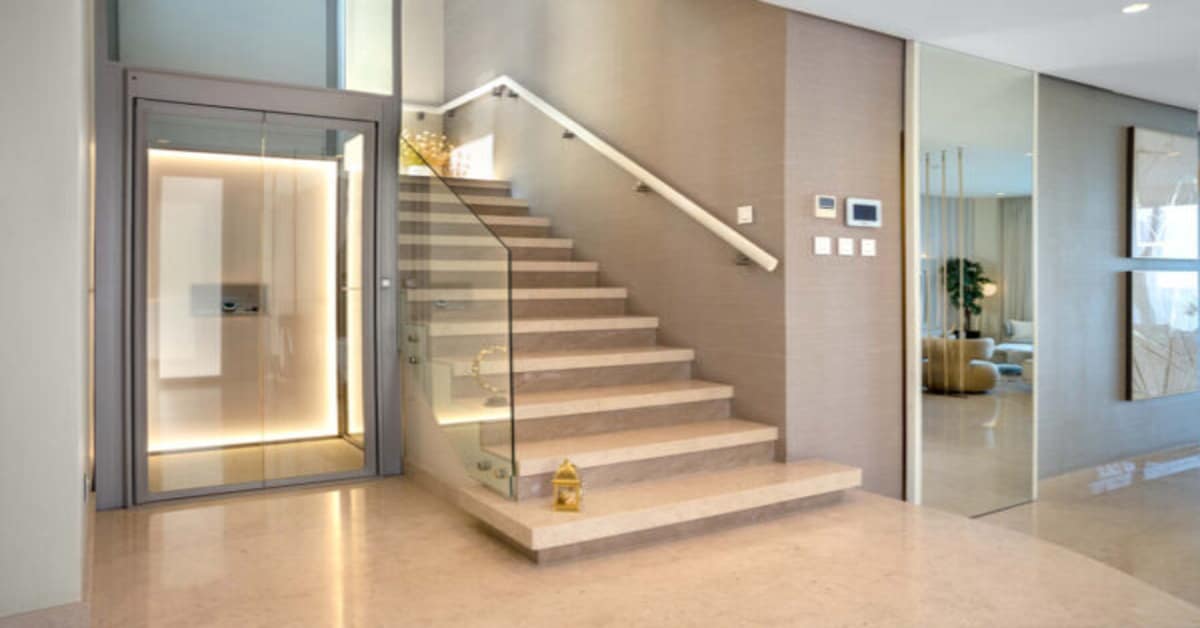
A full enclosed home lift, or residential lift, is closer in concept and experience to the lifts found in commercial buildings. The user enters an enclosed cabin, the doors close, and the cabin travels between floors within a dedicated shaft or self-supporting structure. The experience is complete and contained, the cabin is fully enclosed on all sides and above, and the product is designed to integrate architecturally into the home.
The practical differences between them are significant. A vertical platform lift is typically more compact and lower in cost than a full home lift. It is well suited to short travel heights, single-storey changes in level, and situations where the primary need is wheelchair access between a ground floor and a first floor. A full home lift handles multi-storey travel more elegantly, provides a more complete and comfortable user experience, and integrates more naturally into the fabric of a well-designed home. It is also, correspondingly, a larger investment.
UK Regulations Under BS EN 81-41: What You Need to Know
BS EN 81-41 describes specific standards for vertical lifting platforms with an enclosed liftway operating between levels, intended for use by people with impaired mobility, with or without wheelchairs. This is the primary technical standard that governs vertical platform lifts in the UK residential market, and understanding what it requires is essential for any homeowner or specifier choosing between lift types.
In the UK, platform lifts must comply with strict regulations including BS EN 81-41, which sets the safety standards for vertical platform lifts, the Equality Act 2010, which promotes accessibility and non-discrimination for people with disabilities, and Part M of the Building Regulations, which outlines requirements for inclusive access in buildings.
For wheelchair users specifically, BS EN 81-41 sets minimum platform dimensions that must accommodate a wheelchair and its user. The standard covers door clear widths, landing area dimensions, maximum speed of operation, safety edge and anti-trap requirements, emergency communication, and lowering provisions in the event of power failure. Any platform lift sold and installed in the UK for residential use should carry certification confirming compliance with this standard. If a supplier cannot demonstrate compliance, walk away.
For travel heights of more than 3.0 metres, platform lifts must pass an EC Type examination performed by an accredited European Notified body, and platform lifts must carry an EC declaration of conformity and be CE marked before they can be legally placed into the market.
Part M of the Building Regulations, Approved Document M, adds a further layer of requirements relevant to accessibility. Volume 1, which covers dwellings, sets out the design principles for inclusive vertical movement in residential buildings. For wheelchair user dwellings under the M4(3) category, the minimum internal platform dimensions are 1,100mm by 1,400mm. Controls must be at accessible heights, typically between 900mm and 1,200mm from floor level, and clear door widths must be sufficient for unobstructed wheelchair entry and exit.
Building Control approval is required for any platform lift installation in a UK home. This is not the same as planning permission and is not optional. It ensures the installation is structurally sound, electrically safe, and compliant with fire separation requirements between floors. For through floor homelifts, it is vital to select a product that will maintain fire and smoke protection between floors, whether it is parked upstairs or downstairs, as specified in the relevant fire protection requirements.
Under LOLER 1998, all lifting equipment including residential platform lifts must be thoroughly inspected by a competent person at regular intervals. For a domestic lift used solely by household members in a private home, a thorough examination every six months is the expected standard. This is a legal obligation throughout the lifetime of the installation.
Space Requirements and Suitability: Wheelchair Users vs Ambulant Users
One of the most common points of confusion in the platform lift versus home lift decision is the question of who the product is actually for.
A platform lift configured to BS EN 81-41 wheelchair standards is designed to accommodate a powered or manual wheelchair with its user. The platform area must be large enough for the wheelchair to enter, be positioned, and exit safely. Landing areas at each level must also be clear to allow approach and departure in a wheelchair. For a wheelchair user who cannot transfer and must remain in their chair throughout, the platform dimensions and approach clearances are not negotiable. They must be right.
For ambulant users, meaning people who can walk independently or with walking aids but who find stairs painful, tiring, or risky, the size requirements are less demanding. A smaller platform or a compact enclosed home lift cabin can serve an ambulant user effectively. The priority for this group tends to be safety, ease of operation, and reliability rather than wheelchair-specific spatial compliance.
The distinction matters when choosing between a vertical platform lift and a full home lift. For a wheelchair user who primarily needs to move between two floors of a standard UK terraced or semi-detached house, a platform lift may be an entirely appropriate solution and is often the product funded through the Disabled Facilities Grant process. For a household that wants a product serving multiple floors, where the user may be ambulant today but needs the home to remain accessible as mobility changes further over time, and where the aesthetic of the installation matters, a full enclosed home lift is the better long-term answer.
Cost Comparison: Platform Lift vs Full Home Lift in the UK
For vertical platform lifts in UK residential use, costs vary significantly depending on travel height, platform size, whether the installation is indoor or outdoor, the enclosure specification, and the brand. Entry-level vertical platform lift installations in UK homes typically start from around £5,000 to £10,000 for short travel heights and basic configurations. Larger, fully enclosed platform lift installations with more specified safety features and better finishes can reach £15,000 to £25,000 or more, particularly where structural building preparation is included.
For full enclosed home lifts in the UK, the range is broader. Compact residential home lifts from quality European manufacturers can start from around £16,000 to £20,000 for a two-floor installation. Premium models with advanced drive technology, enclosed shaft structures, designer cabin finishes, and smart control systems typically range from £25,000 to £50,000 and above, depending on the level of customisation and the complexity of the installation.
The cost comparison is not simply unit versus unit. The total cost of ownership over a ten to fifteen year period is the more meaningful number. This includes maintenance, LOLER inspections, energy consumption, parts and repairs, and the residual value the installation adds to the property. A full quality home lift, particularly one with a battery-powered drive system requiring minimal servicing, often closes the cost gap with a platform lift considerably when total ownership cost is the metric.
VAT relief on supply and installation may be available for disabled people or those with a qualifying medical condition, which can meaningfully reduce the effective cost of either product. HMRC guidance on this should be confirmed with the installer at quotation stage.
The Disabled Facilities Grant: What It Covers and How to Apply
The Disabled Facilities Grant is the most significant public funding route available to UK homeowners and tenants needing home adaptation. It is a statutory scheme delivered through local councils and applies to both vertical platform lifts and full home lifts where the installation is necessary for a disabled person to access their home, including high-end residential properties such as villa taicang where accessibility improvements are part of long-term living planning.
In England, eligible applicants can receive up to £30,000 per application to help cover the cost of home renovations that support independent living. The maximum is £36,000 in Wales and £25,000 in Northern Ireland. Scotland operates through the Scheme of Assistance, which provides a minimum grant of 80% of eligible costs, rising to 100% for those in receipt of certain qualifying benefits.
The annual DFG allocation for 2026/27 was increased to £723 million in the 2025 Autumn Budget, and an additional £50 million was announced in January 2026 for the current financial year. This is genuinely significant for homeowners who have been considering an application. The expanded funding pool means more applications are likely to be approved, and 2026 is a particularly strong moment to progress an outstanding application.
For adults, the grant is means-tested. The council assesses household income and savings, and savings do not affect the decision unless they exceed £6,000. For disabled children under 19, the grant is not means-tested. You apply through your local council’s housing department. An occupational therapist assesses your needs and their recommendation carries substantial weight in the outcome. You must obtain at least two written quotes and you must not begin any work before formal approval is given. Starting work before approval almost always disqualifies the application.
The DFG is more commonly used to fund vertical platform lifts than full home lifts, largely because platform lift installations more readily come within the grant maximum. However, where the assessed need makes a full home lift the appropriate solution and the cost falls within or close to the grant ceiling, the DFG can and does fund home lift installations. A skilled occupational therapist and a reputable lift provider working together on your behalf can maximise the scope of what the grant covers.
You must intend to stay at the address for at least five years, and for grants over £5,000, if you move within ten years you may be required to repay up to £10,000.
Which Option Gives Better Long-Term Value?
The long-term value question is where the honest answer diverges from the instinctively cheaper choice.
A vertical platform lift serves its purpose well in specific circumstances. For a short travel height, for a household that needs a compliant wheelchair solution today and is primarily interested in meeting the immediate need, and for budgets that genuinely cannot stretch to a full home lift, a quality platform lift installed to BS EN 81-41 is a legitimate and effective choice.
But for most homeowners who are investing in a permanent adaptation of their home, a full enclosed home lift delivers better long-term value on almost every measure. It provides a more complete user experience. It serves multiple floors. It integrates naturally into the home’s design rather than sitting as an obvious adaptation. It adds more meaningfully to the property’s resale value and future-proof appeal. And as mobility needs evolve over time, an enclosed home lift does not become inadequate in the way that a smaller platform lift can.
Where SWIFT Stands in This Decision
When the decision has been made to invest in a premium, long-term home lift solution, the product specification matters as much as the category choice. SWIFT is the leading name in the premium residential home lift market in the UK, and the reasons for that position are grounded in engineering, design, and a genuine understanding of what UK homeowners need from a domestic lift.
The SWIFT Pro operates on 100% battery power through the proprietary EcoDrive screw and nut drive system. The battery recharges dynamically every time the lift descends, resulting in minimal energy draw from the home’s electricity supply and whisper-quiet operation. For households where the lift will be used multiple times every day, this combination of low running cost and near-silent operation is not a marginal benefit. It materially changes the daily experience of living with a home lift. And when the power goes out, as it still does across parts of the UK, the lift continues to function rather than stranding its user between floors.
BS EN 81-41 ensures your lift is easy to access, even if you use a wheelchair or walker, and the Equality Act 2010 ensures your home complies with accessibility standards while promoting inclusive design for all residents. SWIFT builds to these standards as a baseline and exceeds them in both safety architecture and design quality. The SWIFT Pro features over 20 interchangeable ArtWall panel designs, a dynamic touch-screen control interface, programmable LED cabin lighting, and an aesthetic rooted in Scandinavian design principles that integrates into any modern or period UK property.
The installation footprint is another practical advantage that matters particularly for UK homes. No separate machine room is needed. The pit requirement is just 50mm, and zero-pit installations are possible in certain configurations. For a Victorian semi in Manchester, a Georgian terrace in Bristol, or a new-build townhouse in the home counties, this minimal structural demand means the installation is faster, cleaner, and less expensive in civil works than a conventional lift system.
The SWIFT Lite model brings the same EcoDrive battery technology and SWIFT Safety architecture to a cleaner, more minimal aesthetic at a more accessible price point, making it an ideal choice for homeowners who want European-grade engineering without the full premium customisation of the Pro.
Both models can be configured through the SWIFT Studio online tool, which allows you to visualise your lift combination before making any commitment. To explore which SWIFT model fits your home, your needs, and your budget, visit swiftlifts.com/en for a free consultation and personalised quote.
FAQ’s
1. What is the difference between a platform lift and a home lift in the UK?
A platform lift, technically referred to as a vertical lifting platform, travels on an open or semi-enclosed platform between two levels and is governed by BS EN 81-41. It is generally suited to short travel heights and is a common choice for wheelchair access between one or two levels. A full home lift provides an enclosed cabin experience, travels between multiple floors within a dedicated shaft structure, and offers a more complete, architecturally integrated solution. Home lifts are typically larger, more refined in design, and represent a stronger long-term investment in the property. The two products have overlapping use cases but serve different priorities. For households seeking the best long-term value, a full premium home lift such as the SWIFT Pro consistently outperforms a platform lift across comfort, versatility, design quality, and property value added.


