

Introduction: Why Am I Considering a Domestic Passenger Lift?
The stairs that never bothered you now take a little longer. Perhaps a parent is moving in, a knee operation is booked, or you simply want a home that still works for you in 20 years. Whatever the reason, a domestic passenger lift is one of the few changes that lets you stay in the home you love, on every floor of it.
Home lifts are no longer a luxury reserved for large country houses. Compact, battery-driven models now fit inside ordinary UK semis, terraces and townhouses, often in the space of a cupboard or the corner of a hallway. They need no lift shaft, no machine room and, in many cases, no pit.
This guide answers the questions UK homeowners ask us most: what a domestic passenger lift actually is, how much space it needs, whether you need planning permission, which safety standards apply, what it costs to buy and run, and what help is available through VAT relief and the Disabled Facilities Grant.
TL;DR
- What it is: a domestic passenger lift is a small, enclosed lift that carries people (and often a wheelchair) between floors of a private home. Most modern UK home lifts are platform lifts built to EN 81-41.
- Space: the smallest SWIFT cabin has an 830 × 600 mm floor and needs a 940 × 1025 mm hole through the ceiling. No machine room, no load-bearing shaft and only a 50 mm recess (or none at all).
- Planning permission: rarely needed for a lift inside your home. Building Regulations approval usually is, and listed buildings need listed building consent.
- Safety: look for compliance with the Supply of Machinery (Safety) Regulations 2008, EN 81-41, battery backup, safety edges and dual brakes.
- Cost: SWIFT domestic lifts start at around £18,100 (Lite) and £19,050 (Pro) for two floors, plus about £1,900 for each extra floor.
- Running costs: the first year of servicing is included; after that, an annual service contract keeps the 5-year lift warranty and 10-year drive warranty valid.
- Financial help: eligible disabled people can buy and install a lift at 0% VAT, and a Disabled Facilities Grant can contribute up to £30,000 in England.
What Exactly Is a Domestic Passenger Lift?
A domestic passenger lift is a powered lift installed in a private home to carry people safely between floors. You step in, close the doors, press a button and travel up or down in an enclosed cabin, much like a small version of a lift in a shop or office.
You will see the same product described as a home lift, house lift, residential lift or domestic lift. In the UK, most of these are technically platform lifts: low-speed lifts built to the European standard EN 81-41, which caps speed at 0.15 metres per second and is designed for homes and low-rise buildings.
That low speed is what makes a domestic lift so practical. Because it moves gently and has its own enclosure, it does not need the concrete shaft, deep pit or rooftop machine room that a commercial passenger lift requires.
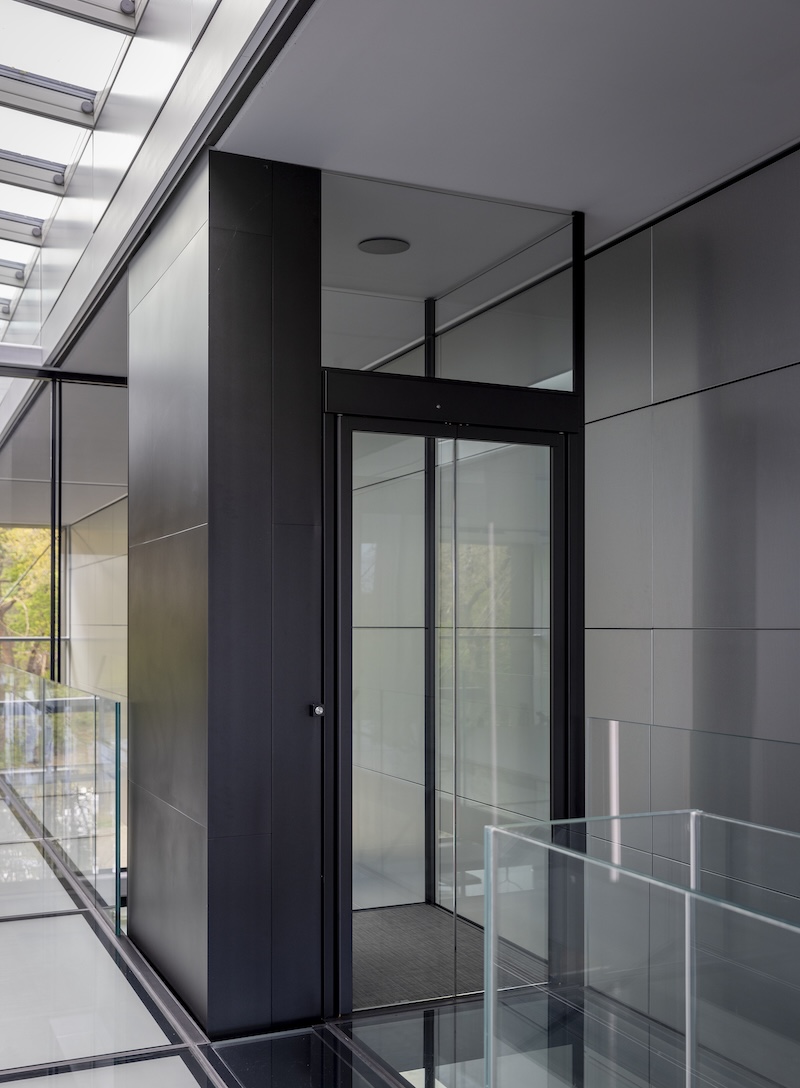
A SWIFT domestic passenger lift, for example, is a self-supporting glass and steel shaft that:
- serves 2 to 6 floors, with up to 20 metres of travel on the SWIFT Pro
- carries 250 kg (2–3 people) or 400 kg (5 people), depending on cabin size
- runs on a screw-and-nut drive powered by an on-board battery that recharges from a standard single-phase supply
- sits on the finished floor or in a shallow 50 mm recess, so no deep pit is required
How Is a Domestic Passenger Lift Different From a Stairlift?
A stairlift moves you along the staircase on a seat; a domestic passenger lift moves you vertically through the floor in an enclosed cabin. That single difference decides who each one suits.
Stairlift |
Domestic passenger lift |
|
| How you travel | Seated, on a rail fixed to the stairs | Standing, seated or in a wheelchair, inside a cabin |
| Wheelchair users | No: you must transfer to the seat and have a second chair upstairs | Yes, with a suitably sized cabin |
| Carrying things | Very limited | Shopping, laundry, luggage, a pushchair |
| Passengers | 1 | 2 to 5, depending on cabin size |
| Effect on the stairs | Rail and seat narrow the staircase | Stairs stay clear for everyone else |
| Where it goes | Only where the stairs go | Almost anywhere: hallway, living room, stairwell void |
| Cost | Usually lower | Higher, but a long-term home improvement |
A stairlift can be the right answer for someone who walks with difficulty but can transfer safely, and who needs a quick, lower-cost solution. A domestic passenger lift is the better choice when a wheelchair user lives in the home, when more than one person needs help, when the staircase is narrow or busy, or when you are planning for the next 10 to 20 years rather than the next 2.
Which Types of Domestic Passenger Lifts Can I Choose?
There are 4 main types of domestic passenger lift in UK homes. They differ in how they are built and driven, which in turn decides how much building work you face.
Type |
How it works |
Typical floors |
Building work |
Best for |
| Through-floor lift | A cabin runs up a wall-mounted rail through a trap opening in the ceiling | 2 | Floor aperture; no shaft | One wheelchair user moving between ground and first floor |
| Platform lift with self-supporting shaft | A cabin inside its own glass-and-steel enclosure, driven by screw and nut, chain or hydraulics | 2 to 6 | Floor apertures; little or no pit; no machine room | Most homes: new builds, renovations, retrofits in hallways or stairwells |
| Hydraulic shaft lift | An oil-filled ram pushes the car; a pump unit sits nearby | 2 to 5 | Pit, built shaft and space for the pump unit | Larger homes where a built shaft is planned from the start |
| Traction (cable) lift | Steel ropes and a counterweight move a full lift car | 3 or more | Built shaft, pit and often a machine room | Large homes and small apartment blocks needing higher speed |
For most UK houses, a platform lift with its own enclosure is the practical sweet spot. It carries a wheelchair, serves several floors and avoids the cost and disruption of building a shaft.
The drive system matters too. Screw-and-nut drives, like the one in every SWIFT lift, have no oil to change and no ropes to stretch. The nut cannot run away down the screw, which makes the system inherently self-locking. SWIFT’s drive also runs from an on-board battery that tops up from the mains, so the lift keeps working normally during a power cut.
SWIFT offers 2 models that share the same drive, safety system and 6 cabin sizes:
- SWIFT Lite: a budget-friendly small house lift with classic buttons, 3 colours, 1 door per floor and up to 15 metres of travel.
- SWIFT Pro: the premium model with a 15.4-inch touch display, 5 colours, interchangeable ArtWalls, up to 2 doors per floor, smart-home integration and up to 20 metres of travel.
How Much Space Does My Domestic Lift Need?
A domestic passenger lift needs less space than most people expect. The smallest SWIFT cabin fits in a hole through the floor of 940 × 1025 mm, about the size of a large wardrobe.
Choose your cabin size first, then plan the opening around it. All 6 sizes are available on both the Lite and Pro models, and the price changes very little between them.
Size |
Cabin floor (mm) |
Rated load |
Hole through floor (mm) |
Suits |
| XXS | 830 × 600 | 250 kg / 2 people | 940 × 1025 | Tight spaces, walking users |
| XS | 830 × 850 | 250 kg / 3 people | 940 × 1275 | Walking users with a stick or frame |
| S | 830 × 1000 | 250 kg / 3 people | 940 × 1425 | Couples, shopping, luggage |
| M | 830 × 1100 | 250 kg / 3 people | 940 × 1525 | Extra legroom, a seated user, a pushchair |
| L | 1200 × 1000 | 400 kg / 5 people | 1310 × 1425 | Wheelchair users, families |
| XL | 1400 × 1100 | 400 kg / 5 people | 1510 × 1525 | A wheelchair user plus a companion |
Beyond the floor opening, check 4 more things:
- Headroom on the top floor: the shaft needs 2,275 to 3,500 mm of height above the top landing, depending on configuration. Most UK ceilings already allow for this.
- Pit: none needed. The lift either stands on the finished floor with a small door sill, or sits in a shallow 50 mm recess for a level, step-free entrance.
- Power: a single-phase 220–240 V supply with an 8 A fuse, usually a dedicated fused spur fitted by your electrician.
- Location: an internal, dry space such as a hallway, stairwell void, living room corner or stacked cupboards. The lift is designed for indoor use only.
Popular locations in UK homes include the void beside the staircase, a ground-floor cloakroom stacked under a first-floor airing cupboard, or a corner of an open-plan living space where a glass shaft becomes a design feature.
Do I Need Planning Permission for My Home Lift?
In most cases, no. A domestic passenger lift installed inside an existing house is an internal alteration, which does not normally need planning permission in England, Wales, Scotland or Northern Ireland.
Planning permission and Building Regulations are two different things, though, and a home lift usually involves the second.
When you will usually need Building Regulations approval: cutting an opening through a floor changes the structure and can affect fire safety and escape routes. In England and Wales, your installer or builder will normally notify your local authority building control or use an approved inspector. In Scotland, the equivalent is a building warrant; in Northern Ireland, Building Control approval from your council.
When you may need extra permission:
- Listed buildings: internal works to a listed building need listed building consent, even with no external change. Councils regularly approve home lifts where the location avoids historic fabric.
- External lifts or extensions: a lift in a new extension or on the outside of the house may need planning permission.
- Flats and leasehold homes: you will need written consent from the freeholder or management company, and possibly the other leaseholders.
- Rented homes: you need the landlord’s permission, though a landlord can apply for a Disabled Facilities Grant on a tenant’s behalf.
A good installer handles this paperwork for you. At SWIFT, our surveyors check the structure, flag any consents you need and supply the technical drawings and certificates building control asks for.
Which UK Safety Standards Must My Lift Meet?
A domestic passenger lift travelling at up to 0.15 m/s is classed as machinery in the UK. It must comply with the Supply of Machinery (Safety) Regulations 2008 and carry a CE or UKCA mark, backed by a Declaration of Conformity from the manufacturer.
These are the standards to look for when comparing quotes:
Standard or rule |
What it covers |
| Supply of Machinery (Safety) Regulations 2008 | The legal requirement in Great Britain for platform lifts and homelifts (the UK version of Machinery Directive 2006/42/EC) |
| BS EN 81-41 | Vertical lifting platforms for people with impaired mobility: enclosures, doors, brakes, speed, controls and load testing |
| BS 5900 | Powered homelifts without a full shaft, such as through-floor lifts |
| BS 6440 | Powered lifting platforms with open or partly enclosed liftways |
| BS 7671 | The wiring regulations your electrician follows for the lift’s supply |
| Building Regulations | Structure, fire safety and escape routes around the floor opening |
| LOLER 1998 | Applies when the lift is used at work, for example by paid carers; requires regular thorough examinations |
Standards set the minimum. The features that make a lift feel safe every day are worth checking separately. Every SWIFT domestic lift is built to EN 81-41 and the Machinery Directive and includes:
- Anti-trap battery backup: the lift keeps running normally during a power cut, so nobody is stuck between floors.
- Dual safety brakes and a self-locking screw-and-nut drive.
- Safety edges and sensors that stop the lift if something is in the way.
- Overload detection with clear on-screen or audible warnings.
- Child lock and access restrictions to stop little ones using the lift alone.
- Emergency stop button in the cabin, plus an emergency phone (standard on the Pro, optional on the Lite).
- Remote support so SWIFT technicians can check the lift’s status without a visit.
How Is a Domestic Passenger Lift Installed?
Most domestic platform lifts are assembled on site in 2 to 5 working days once the floor openings are ready. The whole journey, from first call to first ride, follows 6 steps.
- Home survey: a surveyor measures the space, checks joist direction and floor construction, confirms headroom and agrees the best location with you.
- Design and quote: you choose the model, cabin size, door positions and finishes. With SWIFT, you can start online with Build your lift.
- Approvals: your installer prepares drawings for building control and, where needed, listed building or freeholder consent. If you are using a Disabled Facilities Grant, wait for written approval before any work starts.
- Preparation: a builder cuts and trims the opening through each floor, and an electrician fits a fused spur. Your installer gives exact dimensions for both.
- Installation: the lift arrives in sections that pass through normal doorways. The team assembles the shaft, doors and cabin, then connects and configures the controls.
- Commissioning and handover: the lift is load-tested and safety-checked, then you receive a demonstration, user manual and certificates. Your warranty becomes valid only after successful commissioning.
Because there is no pit to dig and no machine room to build, the disruption is mostly limited to the floor opening. The rest of your home stays usable throughout.
How Much Does a Domestic Passenger Lift Cost in the UK?
A SWIFT domestic passenger lift costs from around £18,100 for a 2-floor SWIFT Lite and £19,050 for a 2-floor SWIFT Pro. Each additional floor adds about £1,900.
Floors served |
SWIFT Lite (approx.) |
SWIFT Pro (approx.) |
| 2 (ground + 1) | £18,100 | £19,050 |
| 3 | £20,000 | £20,950 |
| 4 | £21,900 | £22,850 |
Cabin size has little effect on price, so choose the size that suits your needs today and in 10 years’ time rather than the smallest that fits.
What moves the final price:
- Number of floors and total travel height
- Model and finishes: touch display, ArtWalls, colours, RGB lighting, a second door per floor
- Builder’s work: cutting and trimming the floor openings, then making good and decorating
- Electrical work: a dedicated fused spur from your consumer unit
- Approvals: building control fees and, for listed homes, consent drawings
- Options: emergency phone (Lite), smart-home integration (Pro), ventilation, remote monitoring
When you compare quotes, check each one states whether VAT, delivery, installation, builder’s work and the first year of servicing are included. A cheaper headline price can hide extra costs later.
Two schemes can cut the cost significantly: 0% VAT for eligible disabled people and the Disabled Facilities Grant of up to £30,000 in England. Both are explained in the FAQs below.
What Will It Cost to Maintain My Domestic Lift?
A modern domestic lift costs little to run. The main ongoing cost is an annual service contract, which also keeps your warranty valid.
Electricity: a SWIFT lift draws a maximum of 900 W from a standard single-phase supply and uses about as much energy as an A-rated dishwasher. The battery charges between journeys, so the lift never needs a heavy-duty or three-phase supply.
Servicing: the first year of servicing is included with every new SWIFT lift. After that, you renew the service contract each year. Servicing follows the schedule in the SWIFT User and Maintenance Manual and must be carried out by SWIFT or an appointed local service partner.
Warranty: SWIFT covers the lift for 5 years and the drive screw and nut for 10 years, from the factory shipping date. The warranty stays valid only while the service contract is active. If it lapses, the lift needs a paid technical inspection before a new contract can start, so it pays to renew on time.
What the warranty does not cover: routine adjustments, normal wear and tear, LED lights, faded paint and damage from misuse or unauthorised servicing.
Fewer call-outs: screw-and-nut drives need no oil changes, automatic lubrication is built in, and optional SWIFT Remote lets technicians diagnose many issues without a visit.
If your lift was installed at 0% VAT for an eligible disabled person, its repairs and maintenance can also be zero-rated.
Conclusion: How Do I Choose the Right Domestic Passenger Lift?
The right domestic passenger lift is the one that fits your home, your budget and the way you will live in 10 years, not just today. Work through these 6 questions before you request quotes:
- Who will use it? A wheelchair user needs an L or XL cabin; a walking user can choose a smaller size.
- How many floors? Count every level you want to reach, including a loft room or basement.
- Where will it go? Find a dry, internal space where a 940 × 1025 mm (or larger) opening can pass through each floor.
- Which standards does it meet? Ask for EN 81-41 compliance, a CE or UKCA mark and a Declaration of Conformity.
- What happens in a power cut? Choose battery backup that keeps the lift fully working, not one that only lowers it.
- What is the true cost? Compare total installed prices, service contract terms and warranty length, and check your eligibility for 0% VAT and a Disabled Facilities Grant.
SWIFT’s battery-driven domestic lifts are designed in Sweden for exactly this kind of home: no pit, no machine room, a plug-in power supply and a 10-year warranty on the drive. Build your lift online to see your options, or contact our UK team to book a free home survey.
FAQs
1. Can I get VAT relief on my domestic passenger lift?
Yes, if the lift is for a chronically sick or disabled person and installed in their private residence. HMRC zero-rates the installation of a lift that helps a disabled person move between floors of their own home, along with the goods supplied with it. You sign an eligibility declaration, and your supplier then charges 0% VAT instead of 20%. Later repairs and maintenance can be zero-rated too. Older people who are not disabled, or someone with a temporary injury such as a broken leg, do not qualify for this relief.
2. Can I use a Disabled Facilities Grant to pay for my lift?
Often, yes. A Disabled Facilities Grant (DFG) from your local council can pay for adaptations that help a disabled person move around their home, including lifts. The grant is means-tested (except for disabled children under 18) and capped at £30,000 in England, £36,000 in Wales and £25,000 in Northern Ireland. In Scotland, ask your council about its Scheme of Assistance instead. Apply and get written approval before any work starts, because councils cannot fund work already done.
3. Will my domestic lift work during a power cut?
It depends on the lift. Many domestic lifts use battery backup only to lower you to the ground floor. Every SWIFT lift runs from its own battery, which the mains simply keeps topped up, so during a power cut it continues to work normally at full speed. Nobody gets stuck between floors, and you can still reach every level of your home.
4. Can my domestic passenger lift carry a wheelchair?
Yes, if you choose the right cabin size. SWIFT’s L size (1200 × 1000 mm floor, 400 kg) suits most wheelchair users, and the XL size (1400 × 1100 mm) leaves room for a companion as well. The SWIFT Pro takes up to 2 doors per floor, so a wheelchair can roll in one side and out the other without turning. Your surveyor will confirm the fit against your own chair.
5. Will a domestic lift add value to my home?
It can make your home more appealing to a wider range of buyers. Multi-generational families, older downsizers and wheelchair users all look for step-free access, and a well-designed lift lets a 3-storey townhouse work for them. It also means you are less likely to need a costly move to a bungalow or care setting later on.
Get in Touch!


